In this Guide
Long surveys don't just annoy customers, they skew your data away from your best ones. This survey mistake undermines the numbers that many boards rely on. And it's fixable in under 30 seconds.
Don’t Let a Great Experience Be Undone by a Bad Survey
Who doesn’t love Premier Inn? The Purple Palace.
A clean room, a comfortable bed, friendly staff and reasonable prices. Every time, everywhere.
I stay there loads and I actually look forward to it, because after a hard day’s work, or a stressful journey, it’s totally dependable. They get so much right – there’s a lot that we’d all do well to copy.
But even this beacon of excellence and consistency in customer experience has a blind spot. Ironically, it’s in their customer experience process itself.
It’s the same blind spot behind the phenomenon commonly called survey fatigue — and it starts with a single line in the invitation email.
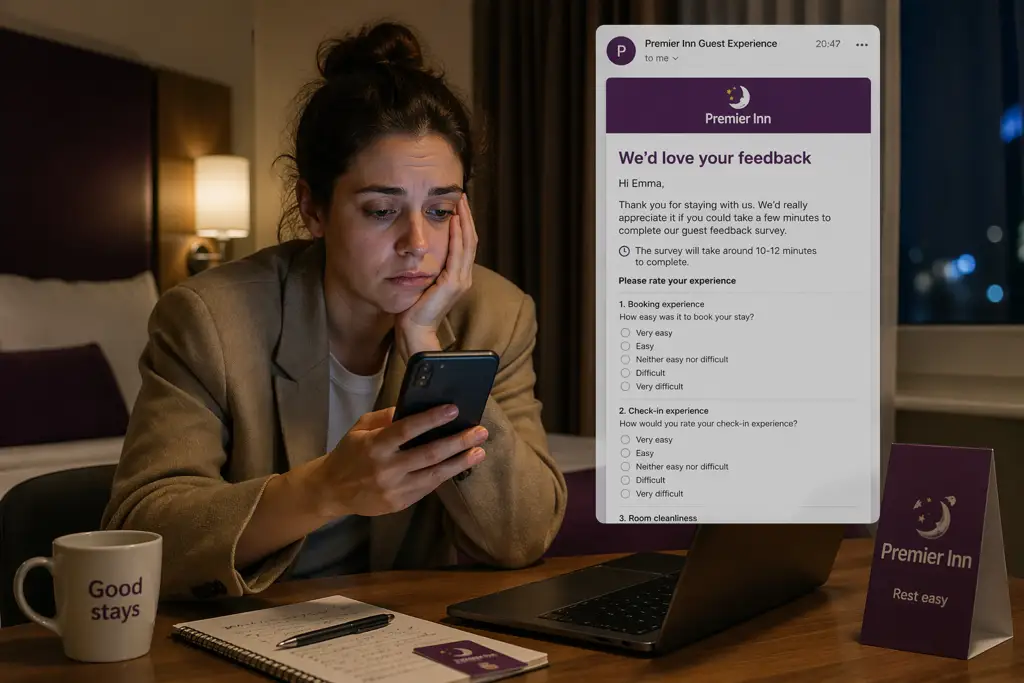
Here’s the offending sentence from their satisfaction survey email. Can you spot the problem?
“Your feedback is super important to us… Don’t worry, it’ll only take 7 minutes to finish.”
Seven minutes?
Here are just three of the many problems with that.
1. A Seven-Minute Survey Is a Bad Customer Experience
Let’s start with the obvious point – one that’s surprisingly easy for organisations to miss.
A seven-minute survey isn’t just “a bit long”. It’s a poor customer experience in its own right.
Consider the context:
- A one-night stay
- Less than £100
- A simple, transactional experience
From the customer’s point of view, being asked to spend seven minutes giving feedback is disproportionate.
And that’s the core issue.
Most surveys are designed around what the business wants to know—not what the customer wants to say.
But if you flip the perspective, the answer becomes clear.
Customers don’t want to be given a laborious burden, analysing what’s important for you. They want to tell you how to make things better for them (or even better), and move on with their day.
If you identify the main things they want you to do brilliantly, you can capture meaningful feedback in under 30 seconds.
That’s enough to:
- Identify issues that need fixing
- Capture improvement ideas
- Confirm what’s working
Anything beyond that introduces friction.
And friction is the enemy of customer experience—whether it’s in your product, your service, or your feedback process.
If you want a simple rule to follow, it’s this: only ask questions about what matters to your customers, not what’s convenient for your reporting.
Then they’ll love your survey as much as the rest of their experience.
2. Long Surveys Reduce Response Rates — and Trigger Survey Fatigue
There’s a persistent belief in CX:
“If we ask more questions, we’ll get better data.”
It sounds logical. It’s wrong.
Longer surveys lead to predictable outcomes:
- Customers abandon them
- Customers rush through them
- Customers ignore them altogether
That pattern has a name: survey fatigue. And all three symptoms reduce the quality of your insight.
In practice:
- More questions → lower completion rates (look at any survey abandon rate data and the correlation is unmistakable)
- Lower completion → less representative data
- Poor data → worse decisions
So teams try to compensate:
- Adding reminders
- Offering incentives
- Pushing harder for responses
But these tactics treat the symptom, not the cause.
The real issue is simple:
You’re asking for too much time.
Customers don’t need prize draws to give feedback. The incentive they need is confidence it’s worth it – that means respecting their time and acting on what they tell you. There are customer-friendly ways to lift response rates without resorting to any of the above.
3. You’re Systematically Ignoring Your Best Customers
This is the most dangerous problem – and the least understood.
Not all customers are equally likely to complete a long survey.
Broadly speaking, your audience splits into:
- Cash-rich, time-poor customers → typically your most valuable
- Time-rich, cash-poor customers → typically less valuable
Guess which group has seven minutes to spare?
Long surveys don’t just reduce response rates—they bias them.
That means you miss:
- Feedback from your highest-value customers
- Insight into premium expectations
- Opportunities for upsell and growth
And instead over-represent:
- Price-sensitive opinions
- Lower-value segments
- Less commercially relevant feedback
This isn’t just a CX issue. It’s a commercial blind spot.
If your Voice of the Customer programme under-represents your best customers, it will quietly steer your business decisions in the wrong direction.
What Should You Do Instead?
The answer isn’t to swing to the other extreme.
A single question (e.g. NPS alone) tells you how strongly customers feel – but not why. And depriving customers of the chance to tell you can be just as frustrating for them.
The Sweet Spot: 3–5 Questions
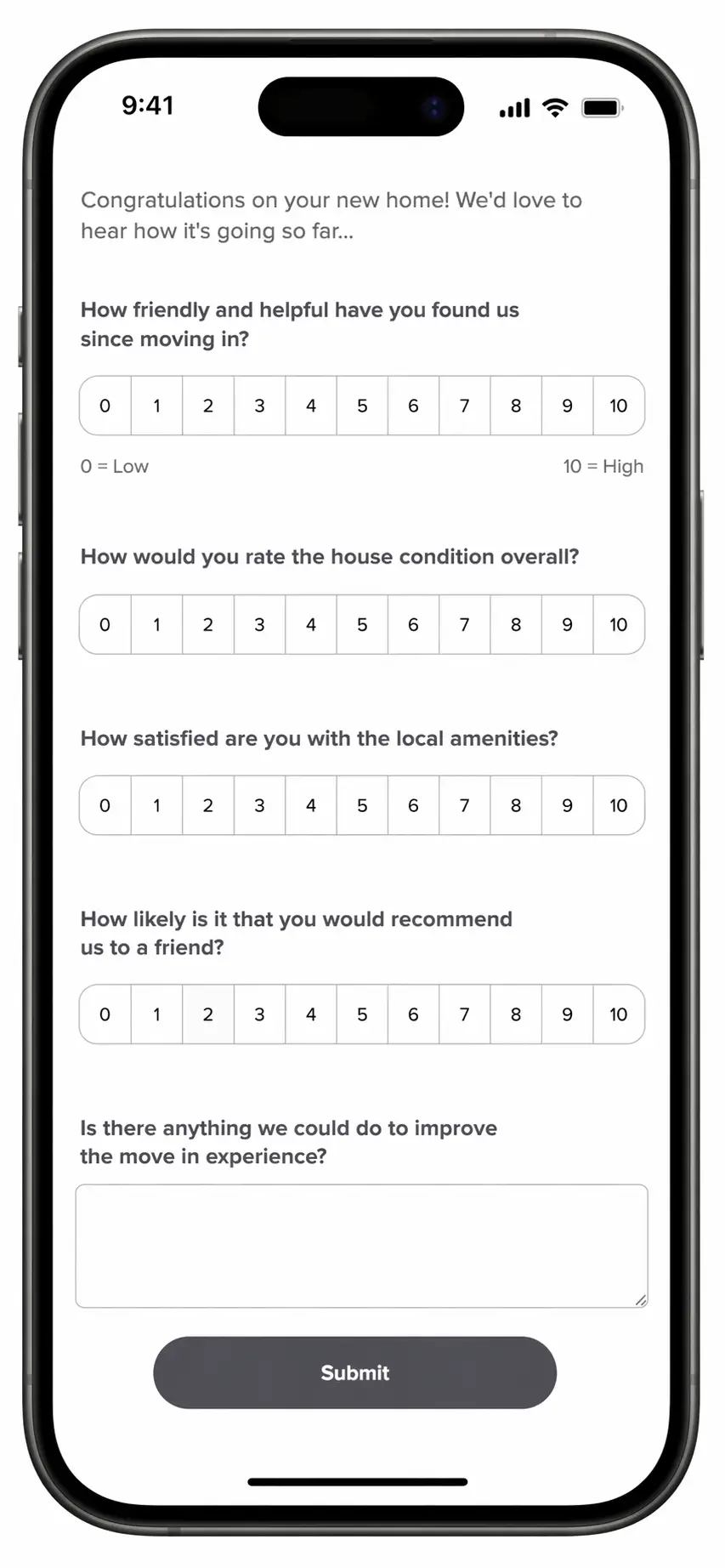
The most effective surveys strike a balance between speed and insight.
A proven structure (based on millions of survey completions that we’ve analysed):
- Three to five scored questions
- Focused on what customers actually care about
- One or two optional open-text comments
This approach delivers:
- Higher response rates
- Better quality insight
- More actionable data
And – crucially – it respects your customer’s time.
It also aligns with broader Voice of the Customer best practice: keep it simple, timely, and actionable.
The Real Lesson for the C-Suite
This isn’t really about surveys.
It’s about a deeper principle:
If your feedback process doesn’t benefit the customer, it won’t benefit your business.
Too many CX programmes drift into:
- Data collection exercises
- Reporting cycles
- Benchmark comparisons
None of these improve customer experience.
Only two things do:
- Understanding what matters to customers
- Acting on it quickly
And that starts with making it easy for customers to tell you.
Because ultimately, measuring satisfaction is only valuable if it leads to the one thing that matters:
Helping you meet the strategic goals of your business.
Design surveys your customers actually want to complete.
Our practical VoC guides show you how to ask fewer, better questions — and turn the feedback you collect into measurable business improvement.