In this Guide
Every CX leader has been asked it: “so what's a complaint actually costing us?” In April we put it to CX leaders in social housing and got the same answer twice — “we’d love to say, we can’t… yet.”
Some vendors might make up some impressive-sounding numbers anyway, but we’d rather explore why this is difficult, and what your realistic best effort looks like.
Every CX leader has been asked the question,
“So what’s a complaint actually costing us?”
We spoke to Matt Thundercliffe at Beyond Housing and Richard Baggott at Connect Housing, both very experienced housing professionals. Both keenly understood the operational benefit of this number, but both admitted to real difficulties in arriving at a ‘true’ figure.
Two CX leaders. One identical answer.
When two experienced practitioners give you the same answer in the space of a fortnight, it’s clearly not a competence problem, it’s intrinsic.
A defensible cost-of-complaint number needs data from at least five places: CRM, the complaints management system, the contact centre platform, finance (compensation pots, regulator fees, write-offs), and operations (rework, repeat visits, second appointments). No single team owns all of those. No single system joins them up.
The stock response is a vendor blog with a made-up “the average complaint costs £X” stat from 2014. Anyone who’s ever sat across the table from a real finance director knows what happens when you put a number like that in a board pack… The conversation moves immediately to where did this come from?
When the answer is “a website”, that’s worse than no number at all.
“I don’t have it yet, and here’s why” is a more defensible position than a fabricated total. It only works, though, if you’re also clear about what you do have.
The only clean numbers are the ones the regulator publishes
Start where the data is cleanest, the regulator’s invoice.
In social housing, Housing Ombudsman referral fees and the operational cost of a stage-2 escalation are externally imposed, therefore countable. Provenance unimpeachable, defensible to any CFO without a footnote.
And the picture could shift… The Housing Ombudsman’s April business plan flagged that they’re exploring new fee models where landlords with effective complaint management pay less.
This means that that number coming from the regulator isn’t simply a static fixed cost, it’s an opportunity for cost reduction. Complaint handling quality might become of direct interest to your CFO.
But everything else… Your time, repeat contact, reputational drag - costs real money that nobody can yet put a clean figure against. The regulator gives you the visible tip of the cost iceberg. The bulk of it sits below the waterline, unmeasured.
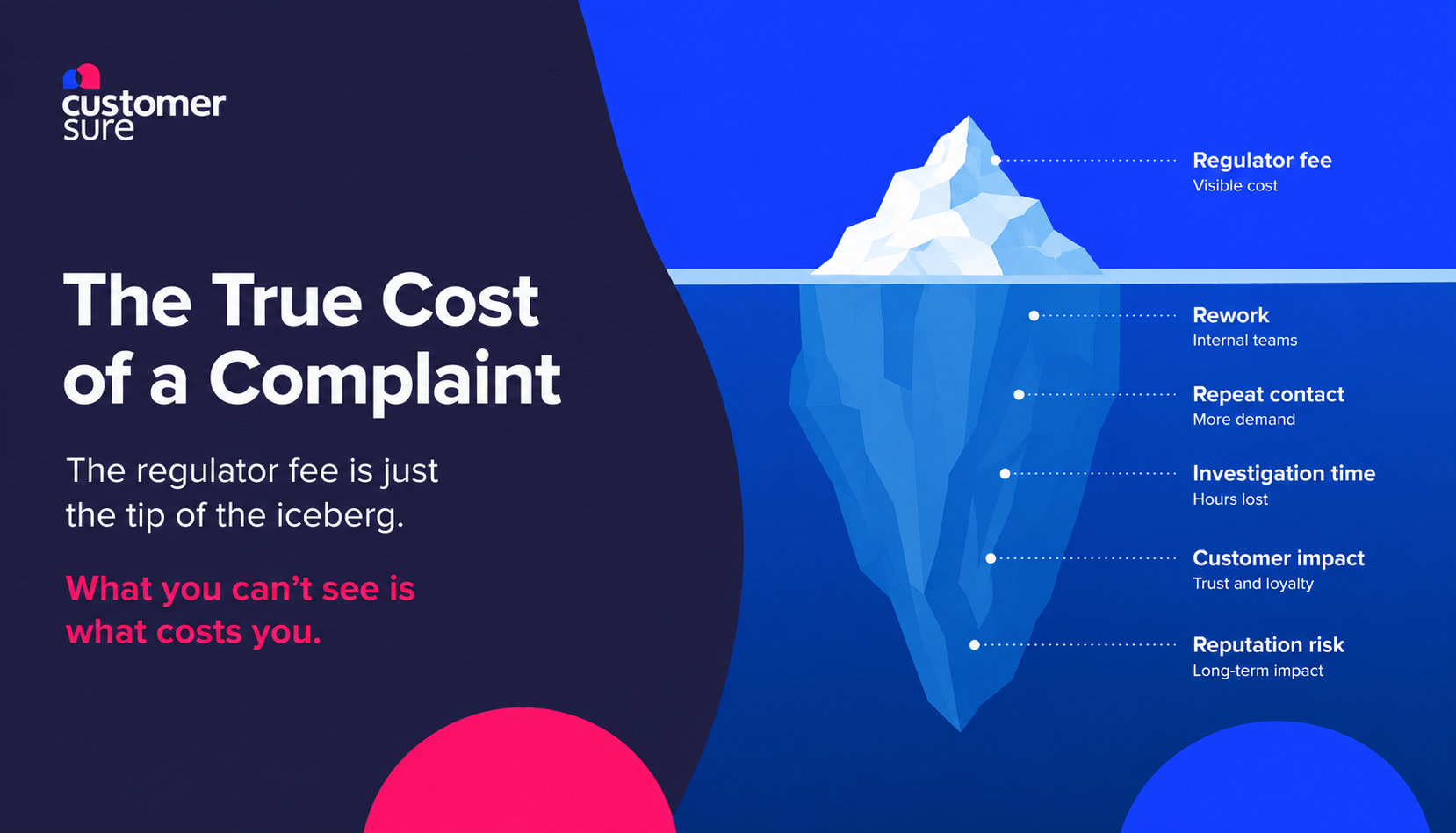
You can cost the symptoms before you can cost the disease
You don’t need a total cost-of-complaint number to improve your best guess though.
The most practical interim move is to quantify what you can cleanly measure, and use it as leverage with the budget holders who caused it.
Matt Thundercliffe at Beyond Housing has a simple ambition:
Compensation pay-outs are already counted; they sit in a single pot, owned centrally. But they should be counted by the originating service area.
Matt’s working towards a model where compensation gets charged back to the team whose service caused it, rather than swallowed centrally. But the number isn’t the true prize… The real win comes from better conversations with service areas about the true cost of customer experience.
CX teams often struggle to demonstrate business value, so this level of attribution becomes a real conversation starter, helping service owners quantify and understand the real value of delivering a good experience.
Of course, this only works if you can group compensation by what actually caused it, which is where verbatim analysis and theme detection earn their keep. It’s the kind of breakdown a CX platform should give you out of the box — comments grouped by cause, compensation attached, the cost trail visible to the team that can do something about it.
(For the related question of how to bring complaint volume down once you can see the themes, our companion piece on reducing complaints goes deeper.)
Stop trying to compute one big number. Start publishing the smaller numbers you do have, attached to the budget that owns them.
When the data isn’t ready, that’s a finance problem before it’s a CX problem
Most CX leaders don’t have a contact-cost data model. The data lives across telephony, finance and BI — which means the case for building it has to be made to finance, not just to the CX sponsor.
Richard Baggott at Connect Housing has been chasing this for a while. The ambition is per-channel cost: phone vs email vs digital. Everyone in the sector uses the informal shorthand — phone is about £3 a contact, email is closer to £6 — but nobody can defend the numbers when pushed.
But Richard is determined to be able to attribute this cost more accurately, and is working on building the data to pitch this to his board.
The hard data is key: Until contact-cost data sits inside a model that finance trusts, no CX leader will get the full picture funded out of their own budget.
The pitch can’t be “give CX more money”. It needs to be “ give the joint CX-and-finance roadmap a sponsor”. The deliberation about what you can’t yet measure is itself part of the evidence — and drawing attention to it helps move the conversation along.
What to do on Monday morning
You don’t need to crack cost-of-complaint to make progress. Three things get you a long way:
Name your one ‘clean’ number. The Housing Ombudsman referral fee. The cost of a stage-2 escalation. Your central compensation pot. Pick the one with the cleanest provenance and lead with it. One defensible number beats five guesses.
Publish a candid “what we can’t yet measure” alongside it. Telephony cost-per-contact. Rework cycles. Repeat-contact rates. Naming the gap is more credible than papering it over. Finance Directors live in the same data-availability constraints you do.
Frame the gap as a joint CX/finance roadmap, not a CX wishlist. Cost-of-complaint isn’t a CX project — it’s a data project that needs a finance sponsor and a slot on the BI roadmap. If you want the case-building scaffolding for that conversation, our CX business-case guide lays out the structure other CX teams have used to win the budget.
The absence of a number is not the absence of cost. The complaints are happening; the work is happening, You just can’t price it yet. That’s your roadmap, not a failure.
If you’re feeling the same as the housing CX leaders we spoke to, you’re in good company — and you’re closer to a defensible position than the people quoting made-up averages.
Walk into the next exec conversation with one clean number, one named gap, and one roadmap ask. Good luck.
(And if you want to push further on quantifying the upside as well as the cost, our ROI-of-CX guide is the obvious next read.)
Want help moving from 'we can't yet' to 'here's the roadmap'?
If you're the CX leader being asked what a complaint costs — and you'd rather walk in with one defensible number, a candid named gap, and a joint CX/finance roadmap than a number you can't source — we're happy to walk through what these two teams are doing in more detail.