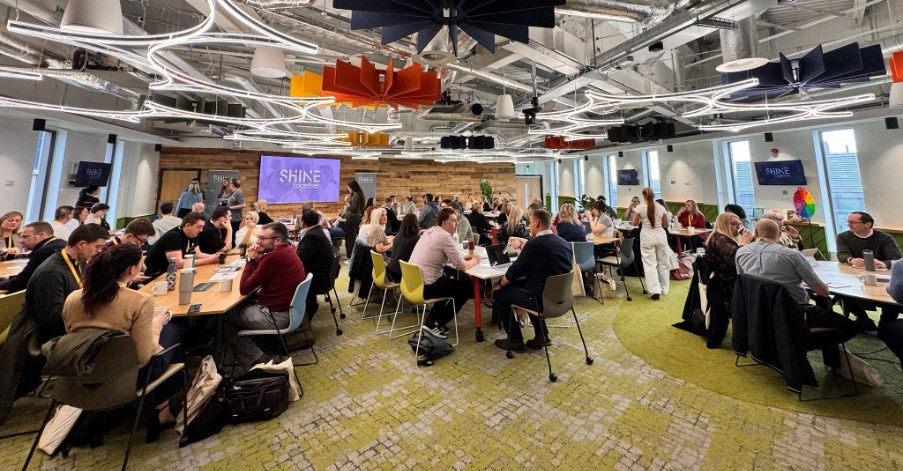
On 18 March 2026, social housing leaders from across the North East gathered at Home Group’s offices in Newcastle for the SHINE (Social Housing Innovationn North East) Together social housing event.
Two standout presentations by Karen Brown (Northern Housing Consortium) and Hannah Underwood (Thirteen Group, Non-Executive Director), offered a compelling and complementary view of where the social housing sector is heading. Taken together, they tell a powerful story.
- On one side: a wave of regulatory change that is raising expectations across safety, quality, and accountability.
- On the other: a call for a fundamentally different way of working; one built on collaboration, data, and culture.
The message is clear: the future of social housing will demand both compliance excellence and system-wide transformation.
The Social Housing Sector Under Pressure
Karen Brown’s session set the tone by outlining the scale of change already underway.
After years of consultation, the sector is now seeing the detail of Decent Homes Standard 2 (DHS2), a significant update to a framework that has been largely unchanged for over 25 years. While the full implementation date sits in 2035, the expectation is not to wait. Providers are expected to progressively meet the standard over the next decade.
And this is not a marginal adjustment. The new standard raises the bar across multiple fronts:
- A zero-tolerance approach to damp and mould, closely aligned with Awaab’s Law
- A requirement for 100% EPC C energy performance, with evolving measurement methodologies
- Increased expectations around safety, quality, and smart readiness
At the same time, regulation itself is changing. The new consumer regulation regime is explicitly proactive, not reactive. It is no longer enough to respond quickly to issues. Providers must demonstrate that they can anticipate problems before they occur.
This creates a significant shift in expectations:
- From fixing issues → predicting and preventing them
- From operational responsiveness → data-driven foresight
And all of this is happening without a corresponding increase in funding.
As Karen highlighted, the current rent settlement is widely seen as sufficient to maintain existing services, but not to fund the uplift required to meet new standards. This creates an unavoidable tension with higher expectations, the same resources.
The “Moving Goalposts” Challenge
One of the most striking insights from Karen’s talk was the idea that the sector is not just facing a higher bar, but moving goalposts.
Even high-performing regions will feel the impact. In the Northeast, where non-decency rates are currently among the lowest in England (around 5%), modelling suggests this could rise significantly under DHS2 definitions, potentially approaching 40% during transition.
This doesn’t reflect a deterioration in housing quality. It reflects a redefinition of what “good” looks like.
The implication is profound:
Maintaining compliance will become more challenging than achieving it historically.
This is particularly true in a regulatory environment where:
- Data quality is scrutinised
- Tenant experience is central
- Safety is politically non-negotiable
A Different Kind of Response Is Needed
If Karen’s presentation outlined the pressure, Hannah Underwood’s session focused on the response. Her central argument is simple but powerful:
The challenges facing housing cannot be solved by individual organisations working alone.
Instead, she called for a shift toward system-level thinking and cross-sector collaboration.
Drawing on her experience in the charity sector, Hannah described a familiar pattern: organisations doing excellent work locally, but within systems that are fragmented, inefficient, and ultimately limiting their impact.
In her words, many are “playing a game that no one is ever going to win.”
The issue is not capability, it is co-ordination.
From compliance pressure to practical improvement
If rising standards are increasing scrutiny on complaints and tenant experience, this guide shows how Social Housing providers can turn feedback into structured insight, faster action, and measurable TSM progress.
The Untapped Power of Collaboration
One of the most compelling ideas from Hannah’s talk is that the solution already exists, but it is distributed. Different sectors bring different strengths:
- Charities and community organisations: deep trust, lived experience, access to residents
- Social Housing providers and public sector bodies: scale, infrastructure, data, investment
Individually, each has gaps. Collectively, they have the potential to address them. But this requires a shift in mindset, from organisational performance to collective impact. It also requires practical change:
- Sharing data and insight
- Co-designing services with communities
- Building partnerships that go beyond transactional relationships
Social Housing Data. From Compliance Tool to Shared Asset
A major theme across both presentations was the role of data. For Karen, data is now central to regulatory compliance. Providers are expected to use it to:
- Identify risk (e.g. damp, energy inefficiency)
- Prioritise interventions
- Demonstrate proactive management
For Hannah, data is also central but in a different way. She emphasised that data should be:
- Accessible, not siloed
- Useful to frontline teams, not just analysts
- Shared across organisations, not held in isolation
She also highlighted a growing risk: data inequality.
Many community and voluntary organisations, despite their deep insight, lack access to the tools, skills, and infrastructure needed to participate fully in a data-driven system. Without intervention, they risk being left behind.
The opportunity, therefore, is not just to use data better, but to use it together.

Culture is The Missing Ingredient in Social Housing
Alongside systems and data, Hannah placed strong emphasis on culture. She identified three core behaviours that underpin effective collaboration and innovation:
- Curiosity – the willingness to ask questions and challenge assumptions
- Bravery – the confidence to try new approaches and work beyond boundaries
- Kindness – the foundation of trust and meaningful partnership
These may sound simple, but their implications are significant. In practical terms, this means creating environments where:
- People feel safe to ask “difficult” or “naive” questions
- Frontline insight is valued and acted upon
- Learning is prioritised over blame
This is particularly important in a data-driven context. When frontline staff are empowered to use and question data, it creates a virtuous cycle:
- Better engagement → better data → better decisions → better outcomes
From Reactive to Predictive, and From Siloed to Systemic
When viewed together, the two presentations point to a clear direction of travel. The Social Housing sector is being asked to move:
- From reactive repairs to predictive, data-led operations
- From organisation-centric delivery to system-wide collaboration
- From compliance as a function to compliance embedded in everyday decision-making
This is not a small shift. It is a transformation in how social housing organisations operate.
What This Means in Practice for Social Housing Providers
The implications are both immediate and strategic.
In the short term:
- Strengthen data quality and insight capability
- Prepare for proactive regulatory scrutiny
- Improve visibility of tenant experience and outcomes
In the medium term:
- Invest in predictive modelling and analytics
- Build cross-sector partnerships
- Embed a culture of curiosity and continuous learning
And at a strategic level:
- Rethink how value is created, not just within the organisation, but across the system
The Opportunity Ahead
While the challenges are significant, both speakers were ultimately optimistic. There is a real opportunity, particularly in regions like the Northeast to lead the way in:
- Collaborative working
- Community-led innovation
- Data-enabled decision making
As Hannah put it, the region has the potential to become a beacon for social impact innovation. But this will only happen if organisations are willing to work differently.
Final Thought
The SHINE Together event highlighted a fundamental truth:
The future of social housing will not be defined by regulation alone, but by how the sector responds to it.
Success will depend on organisations that can:
- Meet rising standards
- Use data intelligently
- Work collaboratively across boundaries
In short: Those that can combine compliance with collaboration will be best placed to thrive.
Move from reactive reporting to proactive insight
Discover how Social Housing providers use better feedback visibility to support regulatory confidence, frontline action, and stronger tenant outcomes.


Darren Wake
Darren Wake leads Customer Success at CustomerSure, where he helps clients act on feedback in ways that improve retention, increase revenue, and reduce customer effort. With a background in marketing, research, and experience design, he’s worked with teams across sectors to align internal processes with what matters most to customers. Known for his practical, plain-speaking approach, Darren helps organisations keep things simple, focus on the essentials, and deliver measurable improvements.