In this Guide
Understanding what your customers think about your business is key to building long-term relationships. Two common metrics to gauge customer sentiment are Customer Satisfaction Score (CSAT) and Net Promoter Score (NPS). They serve different purposes, but both provide valuable insights that help businesses refine their CX strategies.
But improvement isn’t about collecting data — it’s about using insights to build better relationships, improve quality, and drive growth.
The metric you choose matters less than how you use the feedback to drive real change. The key to improvement isn’t just collecting scores — it’s taking meaningful action.
This guide explores CSAT vs NPS: their key differences, when to use each, and how to use them effectively for business growth.
Understanding Customer Satisfaction Metrics
If you want the short version, here it is:
- Use CSAT when you want to understand how customers felt about a specific interaction, such as a support case, delivery, repair, onboarding step or purchase.
- Use NPS when you want to understand loyalty and whether customers are likely to stick around, buy again, and recommend you.
- Use both together when you need to understand both the immediate experience and the strength of the wider customer relationship.
The most important thing is not to treat CSAT and NPS as interchangeable. They answer different questions, and that means they should trigger different follow-up actions too.
CSAT vs NPS at a glance
| Question | CSAT | NPS |
|---|---|---|
| What does it measure? | Satisfaction with a recent experience | Loyalty and likelihood to recommend |
| Best time to ask | Immediately after a transaction or touchpoint | Periodically, when the customer has enough history with you |
| Best for | Repairs, support, onboarding, delivery, complaint handling | Relationship health, retention risk, brand advocacy |
| Biggest blind spot | Doesn’t tell you much about long-term loyalty | Doesn’t tell you which part of the experience went wrong |
| Best follow-up | ”What made you give that score?" | "Why did you give that score, and what should we improve?” |
So the short answer to “Is CSAT the same as NPS?” is ‘no’. CSAT is about a moment. NPS is about the relationship.
CSAT: Measuring Immediate Satisfaction
Customer Satisfaction Score (CSAT) is more flexible than NPS and isn’t owned by any particular organisation. It allows businesses to adapt the question format and scoring system to their needs.
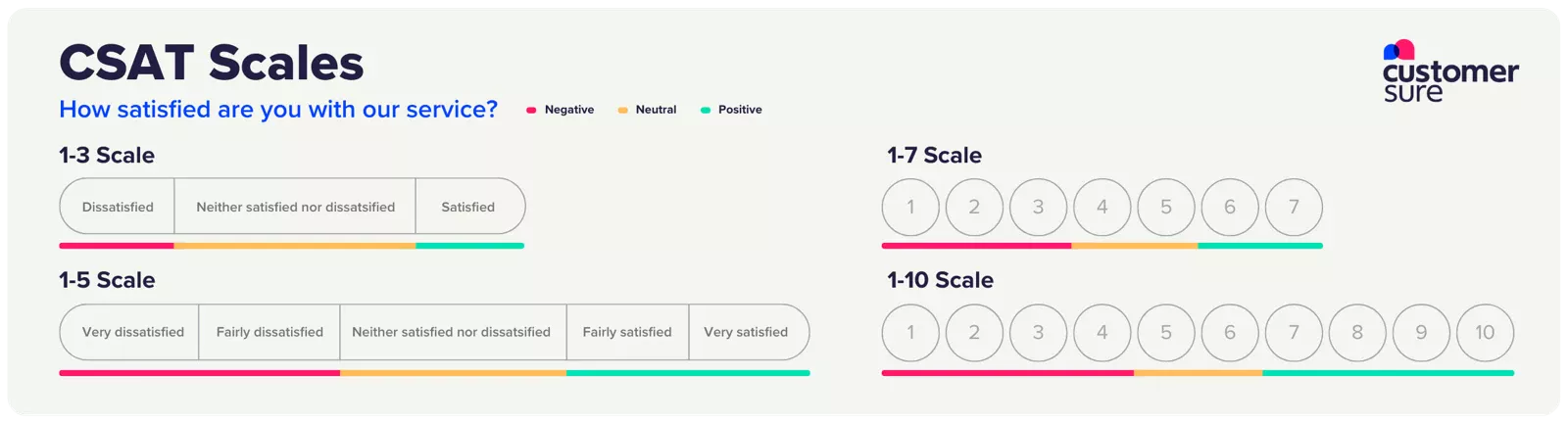
Customers are asked: “How satisfied were you with [specific experience]?” They respond using a scale (e.g., 1–3, 1–5, 1–7 or 1–10), often with response labels like “Very Unsatisfied” to “Very Satisfied.”
In regulated industries like financial services, CSAT is also used for compliance and performance benchmarking. See the FCA’s latest service metrics for how it’s assessed in financial services.
CSAT is much more flexible than NPS. There’s no standard definition, but that’s not necessarily a bad thing. It does mean that it’s completely flexible for you to use and adapt how you want it to work.
— Guy Letts, CEO at CustomerSure
Pros and Cons of CSAT
| Pros | Cons |
|---|---|
| Flexible – Can measure both loyalty and interactions. | ‘Satisfied?’ is weaker than ‘Recommend?’ – Doesn’t provide the same advocacy insight as NPS. |
| Simple for customers – Easy to understand and answer. | Better for retention than referrals – CSAT focuses on fixing issues rather than driving recommendations. |
| Simple for staff – Easy to implement and interpret, making it accessible for teams across departments. |
How to Calculate CSAT
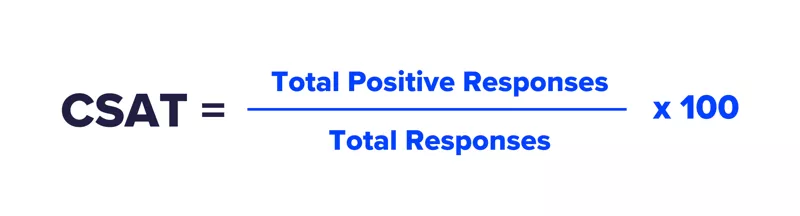
CSAT is calculated using the formula: CSAT = (Total positive responses / Total responses) x 100
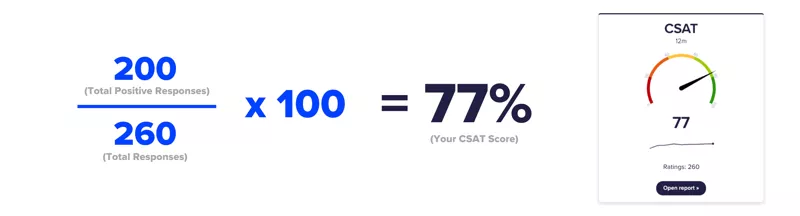
For example, if 200 out of 260 respondents rate their experience as 4 or 5 (in 1-5 scale), the CSAT score would be: (200/260) x 100 = 77%
While calculating CSAT is straightforward, using it as a target can be misleading. Since satisfaction is subjective, focusing solely on increasing the score may not always improve customer experience. Instead, setting better, objective targets leads to meaningful improvements. Find out why setting a CSAT target can backfire — and what to do instead.
NPS: Gauging Customer Loyalty
Net Promoter Score (NPS) was pioneered by Fred Reichheld and his team, who discovered a strong correlation between a specific question and business growth.
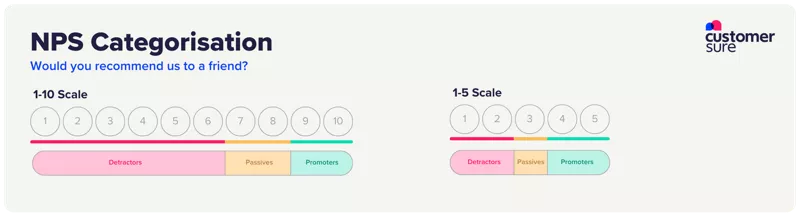
Customers answer: “What is the likelihood that you recommend company X to a friend or colleague?” using a scale from 0 to 10. Responses fall into three groups:
- Promoters (9-10): Loyal customers who advocate for your brand.
- Passives (7-8): Satisfied but unlikely to recommend.
- Detractors (0-6): Unhappy customers who could damage your reputation.
NPS is calculated by subtracting the percentage of detractors from the percentage of promoters. Some companies use a 1 to 5 scale for NPS, which can still provide meaningful insights. Learn more about calculating NPS on a 1-to-5 scale.
Pros and Cons of NPS
| Pros | Cons |
|---|---|
| Popular & familiar methodology – Widely recognised. | Measures loyalty but not service quality – Doesn’t capture experience specifics. |
| Simple for customers– A single, easy-to-answer question. | Question frustrates new customers – It assumes they have enough experience to recommend. |
| ‘Recommend?’ question is more challenging than ‘Satisfied?’ – Forces a deeper response. | NPS calculation is not well understood – Many businesses misinterpret its meaning. |
| Highlights importance of follow-up – Helps businesses focus on post-feedback actions. | Doesn’t tell you what’s important to customers – Needs follow-up questions to diagnose issues. |
The best thing about Net Promoter Score is that the methodology emphasises the importance of closing the loop—that is, following up on whatever your customers feed back to you. That should be a huge advantage, but what I see is that many people fall down here. They don’t get the benefits that they should because they focus too much on just the measurement of Net Promoter Score and not enough on the follow-up.
Guy Letts, CEO at CustomerSure
How to Calculate NPS
NPS is calculated using the formula: NPS = % Promoters - % Detractors
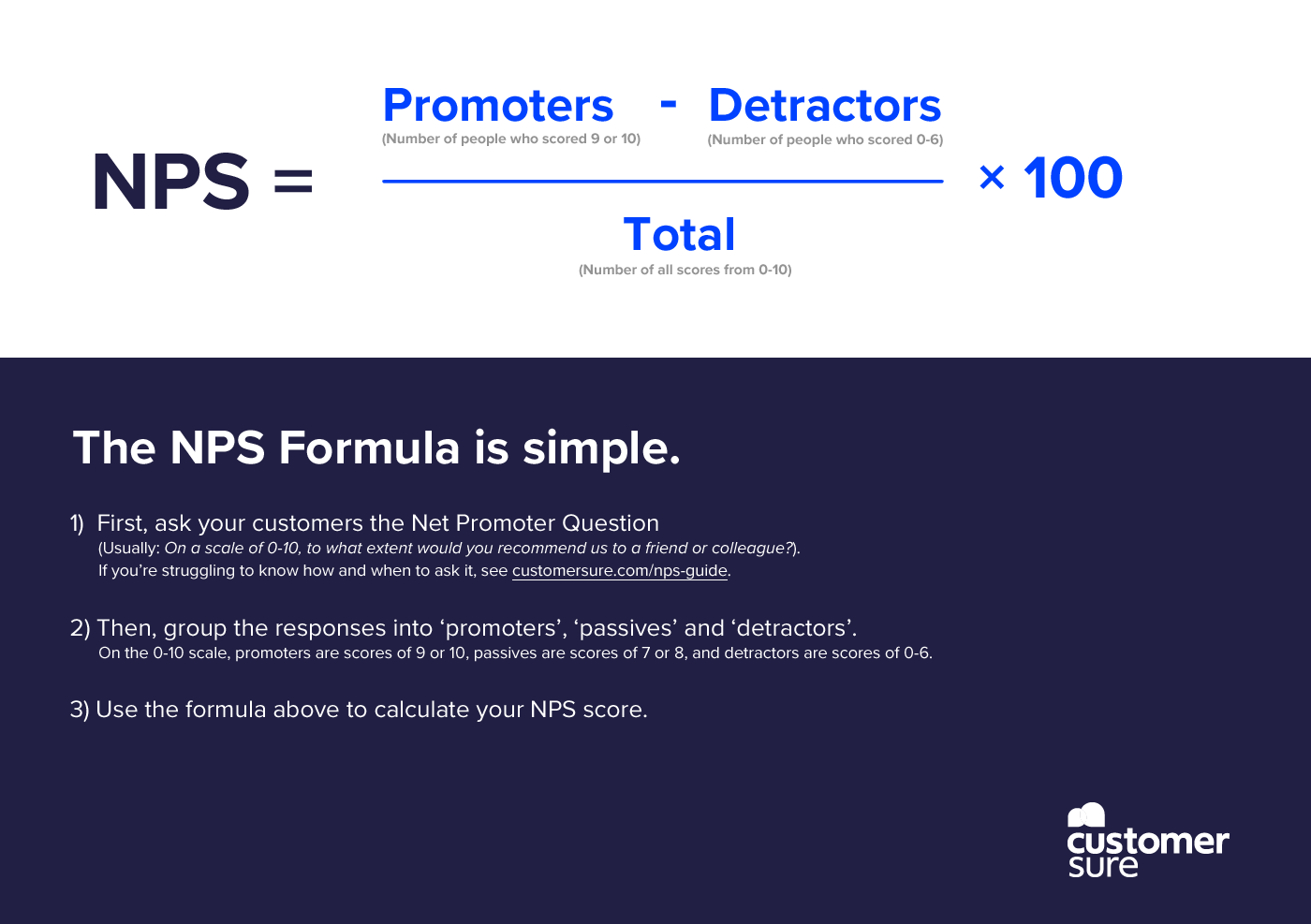
For example, if you survey 500 customers and receive:
- 300 Promoters (60%)
- 100 Passives (only included when calculating the total)
- 100 Detractors (20%)
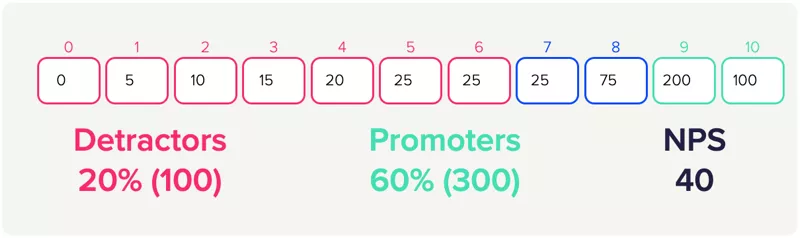
Your NPS score would be: 60 - 20 = 40
Explore a detailed breakdown of how to calculate NPS.
What is Customer Effort Score (CES)?
While CSAT and NPS focus on satisfaction and loyalty, Customer Effort Score (CES) measures how easy it is for customers to complete a specific interaction, like getting support or making a purchase. A low-effort experience often leads to higher satisfaction and loyalty, making CES a useful complement when evaluating service efficiency. Find out more about the benefit of understanding customer effort.
Customer Effort score is useful when used in conjunction with CSAT, NPS, or both, because it helps to drive improvements in customer experience.
Key Differences Between: CSAT vs NPS
Both CSAT and NPS provide useful insights, but they serve different purposes in measuring customer experience. CSAT helps businesses understand short-term satisfaction by focusing on specific transactions, while NPS provides a broader view of brand loyalty and advocacy.
| Feature | CSAT | NPS |
|---|---|---|
| Measures | Satisfaction with a specific experience | Overall customer loyalty |
| Timing | Immediately after an interaction | Periodic (e.g., quarterly or annually) |
| Question Type | ”How satisfied were you?" | "How likely are you to recommend?” |
| Scale | Typically 1-5 or 1-7 | 0-10 scale |
| Calculation | % of positive responses | % Promoters - % Detractors |
| Best For | Short-term insights | Long-term customer sentiment |
While CSAT is excellent for identifying immediate customer concerns or weaknesses in operational performance that need to be improved, it is not designed to measure long-term commitment. NPS, on the other hand, helps businesses assess customer loyalty.
In practice, to work successfully both CSAT and NPS require at least one additional free-text question to be asked to allow customers to comment on their experience. The score and the comment then work hand in hand to indicate an area of strength or weakness, and also its severity, (depending on the score) and what corrective action is required (according to the comment).
Many businesses use both CSAT and NPS together to gain a comprehensive view of customer experience.
- A bank might use CSAT to assess satisfaction after applying for a loan and NPS to measure whether customers are likely to stay loyal over time.
- A social housing organisation could use CSAT to track tenant satisfaction after a repair and NPS to evaluate overall trust in their housing services.
- An energy & utilities provider may use CSAT to measure satisfaction after an engineer’s visit and NPS to assess long-term customer trust and likelihood to renew contracts.
By combining both metrics, businesses can balance short-term customer sentiment with broader loyalty insights. This dual approach allows organisations to fix immediate pain points while also ensuring long-term customer advocacy.
When should you use CSAT, and when should you use NPS?
The simplest way to choose is to think about the touchpoint you are trying to measure.
Use CSAT when you need feedback on something recent and specific:
- after a support interaction
- after a delivery, installation or repair
- after onboarding or training
- after a complaint has been resolved
Use NPS when you want to understand the health of the wider relationship:
- whether customers are becoming more loyal over time
- whether they are likely to recommend you
- whether bigger strategic changes are improving trust
- whether entire customer segments are at risk of drifting away
If you ask NPS too early, customers may not know you well enough to answer meaningfully. If you use CSAT as your only headline measure, you may miss the fact that customers are satisfied with individual interactions but still not especially loyal.
Should you use CSAT and NPS together?
Usually, yes.
CSAT and NPS work best together when they are doing different jobs rather than competing for the same one. A good setup looks like this:
- CSAT tells you whether a touchpoint worked.
- NPS tells you whether the relationship is getting stronger.
- Free-text feedback tells you why the score moved and what needs attention.
For example, you might see strong CSAT after support cases but weak NPS overall. That usually means your frontline teams are rescuing customers well, but the wider experience still has problems. Equally, a decent NPS can hide weak touchpoints that create unnecessary effort, which is where Customer Effort Score can help.
The most useful next step after either metric is not more reporting. It is responding to customer feedback and fixing the operational causes behind the score.
Can you convert CSAT to NPS?
Not reliably.
CSAT and NPS use different questions, different scales, and different logic, so there is no trustworthy formula for converting one into the other.
You can compare how both metrics trend over time, and you may find they often move in the same direction. But that does not mean they are equivalent. A rise in CSAT might mean your service teams are handling interactions better. A rise in NPS usually suggests a broader improvement in trust, loyalty or advocacy.
If you need both answers, ask both questions at the right moments instead of trying to translate one score into the other afterwards.
Common mistakes when comparing CSAT vs NPS
The most common mistakes are:
- Using one metric as a substitute for the other. They answer different questions.
- Asking NPS too soon. New customers often do not have enough experience to give a meaningful recommendation score.
- Judging CSAT without context. A “good” CSAT can still hide recurring issues if you never read the comments.
- Obsessing over the number instead of the cause. The score is only useful if it helps you identify what to improve.
- Skipping follow-up. A low score with no response is often worse than not asking in the first place.
That last point is the most important. Whether you measure satisfaction, loyalty, or effort, the value comes from the action you take afterwards, not from the dashboard alone.
CSAT vs NPS: Which Metric Should You Choose?
The best metric for your business depends on what you want to achieve:
- CSAT is a flexible, all-purpose metric that measures satisfaction with both individual transactions and overall experience.
- NPS focuses on long-term loyalty, assessing how likely customers are to recommend your business.
- CSAT + NPS together is often the best combination if you have enough customer touchpoints to ask both without over-surveying people.
Whichever you pick, ensure it’s used consistently across your organisation to measure and improve satisfaction. Most importantly, design a strategy for responding immediately to at-risk customers, turning insights into action before it’s too late.
If you are still deciding where to start, begin with the question that fits the customer’s experience best, then build out from there. You can learn more about customer satisfaction metrics, how to measure customer satisfaction, and NPS benchmarks in our related guides.
The key thing is to think about your customer on the receiving end of this question and choose the question that’s going to be most appropriate for them at that point in dealing with you. Is the question going to seem awkward, or is it going to feel appropriate?
— Guy Letts, CEO at CustomerSure
How CustomerSure Can Help
At CustomerSure, we believe that collecting feedback is only the first step. What truly makes the difference is how you act on it.
We help businesses turn customer feedback into actionable improvements that drive loyalty, satisfaction, and retention. Our clients effortlessly gather CSAT, NPS (and CES) measurements across multiple channels, but most importantly they make sure they take the right actions to drive up loyalty and customer experience.
Our Voice of the Customer (VoC) platform makes it easy to:
- Automate surveys at the right moments.
- Use AI-driven sentiment analysis for actionable insights.
- Close the feedback loop by turning insights into real change.
Ready to make the most of your customer feedback? Book a discovery call to see how CustomerSure makes CSAT and NPS (or CES) measurement effortless.