In this Guide
Flagging a job as “service recovery” is meant to protect the customer. In practice, it can make the work harder: the label has to be noticed, understood, respected, and interpreted correctly every time. This piece argues that recovery work should look normal to the frontline, while the CX team keeps track of context and closes the loop with the customer.
The standard advice on service recovery is familiar enough: apologise, remedy the problem, close the loop, win the customer back. That advice is not wrong, but it often skips a harder question: how does the recovery work actually reach the people doing the job?
In many service businesses, the answer is some version of a flag, escalation, or special instruction. The job is marked as complaint-related. The scheduler is asked not to move it. The operative is told,
“this one needs particular care”.
That sounds sensible. But it can also create the opposite effect. A flag that is meant to protect the customer can become just another label in a busy queue. A special instruction can feel like scrutiny rather than support.
This piece argues that the recovery context is best kept with the CX or complaints team, and the practical work flows through normal operations. The customer still gets the right follow-up. The frontline team gets a clear job to do. And service recovery becomes business as usual.
What service recovery actually is
Service recovery is the work an organisation does to put things right after a service failure: acknowledge, remedy, fix the root cause, and (in the academic literature) hope to land the “service recovery paradox” — the idea that a customer well-recovered ends up more loyal than one who never had a problem. If you’re here for that definition in long form, our complaints guide is the better page for it.
The textbook definition is fine. But the textbook model can be a problem.
Why visible service recovery breaks down
Flagging a job as “service recovery” is meant to elevate it. But it can have the opposite effect.
In theory, flagging a job as complaint-related should make it safer. It tells the scheduler this one matters, and it tells the operation not to let the customer down twice.
But the flag does not guarantee a better outcome. The scheduler still has to balance access, availability, geography, urgency, capacity, and the rest of the day’s work. A “do not move” label may help in some cases, but it can also become one more instruction competing with all the others.
That is the weakness in visible service recovery: it depends on the flag being noticed, understood, respected, and acted on correctly every time. If the organisation is not actually improving its ability to turn jobs around correctly, the same job can simply be done badly twice — the second time with more data attached.
A normal work order says: here is the task, here is the customer, here is what needs doing. A complaint-related work order says something extra: this job is being watched. That may be useful in some situations, but it is not neutral.
It relies on the operative interpreting the flag exactly as intended: not as blame, not as special handling, not as a reason to be defensive, but simply as useful context. Some will. Some will not. The point is not that frontline staff are the problem. The point is that operational processes need to work regardless of who is handling the case.
The best teams we work with separate the two jobs. The practical work arrives as a normal work order, without unnecessary baggage. The recovery context stays with the CX or complaints team, who understand the history, manage the relationship, and close the loop with the customer.
Stop counting complaints. Watch upheld rate instead.
“Reduce complaint volume” is a nice sounding claim that vendors like to make. But it’s not a claim that survives contact with reality.
In social housing, volumes are rising sector-wide. Tenants are using AI to draft complaint letters in seconds, and cost-of-living pressure is making people angrier and quicker to escalate. A vendor who promises to bring your complaint count down is selling you a number you can’t control.
A better metric is the share of complaints where the regulator (or your internal review) finds in the customer’s favour.
Along with the rest of the housing sector, Beyond’s complaint volumes have risen. But their upheld rate has trended down.
This is more down to the clear focus and hard work of the team at Beyond than their choice of VoC platform, but it shows what good people can achieve with good tools.
There are two kinds of voice-of-customer supplier. One promises to reduce your complaints. The other says: we can show you where the problems are, give you the chance to fix them, and stay involved while you improve the programme. What happens next is still your operational job.
If you do want the considered case for when complaint-volume reduction is a fair thing to talk about, we’ve written about that separately.
Stage Zero: Stop complaints becoming complaints
Once you’ve stopped chasing the wrong number, the next question is how to improve the one you are chasing. The best service recovery happens before there’s anything to recover from.
The mechanism is simple: trigger an action on what the customer wrote, not on the score they gave. A 6/10 on its own is a number. A 6/10 with the verbatim “the engineer was late and didn’t call” is something an operational team can act on. In CustomerSure, verbatim alerts route the customer’s words straight to the person who can do something about them — before the matter has had time to become a formal complaint with all the cost and friction that brings.
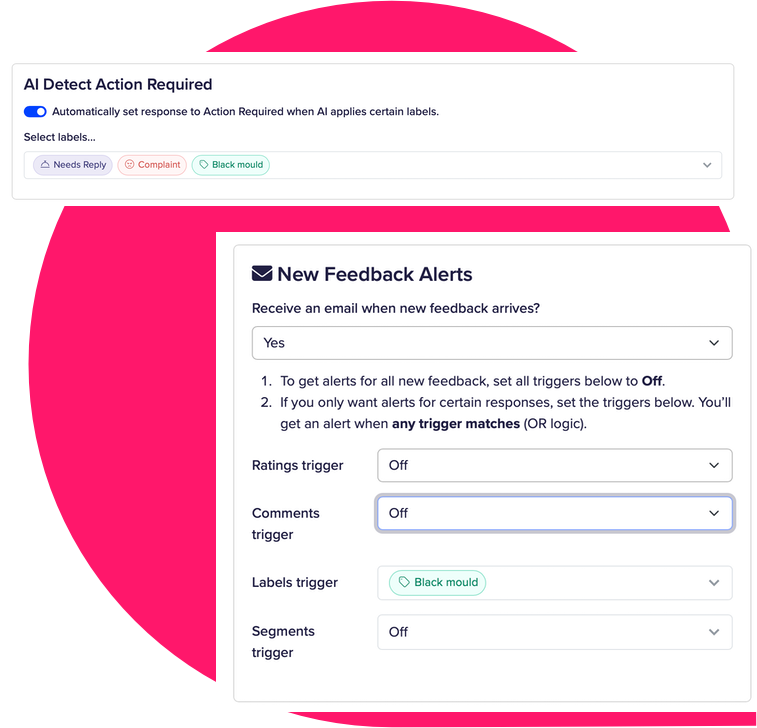
The earlier you spot a customer problem, the more options you have.
That is the point of Stage Zero. It is not about avoiding complaints by hiding them. It is about acting on feedback while there is still time to fix the situation properly. We make the wider case for this in our piece on moving CX work upstream.
What invisible service recovery looks like in practice
Stage Zero handles the upstream work.
For the cases that do become recovery jobs, follow these three steps to success:
1. One Job Queue
The recovery action enters the same job queue everyone else uses. No “recovery queue.”
2. Same Work Order
Second, the operative receives a regular work order. Same format, same expectations. They turn up, do the work, leave. They don’t know — and don’t need to know — that the job exists because of a satisfaction score. As Matt Thundercliffe at Beyond puts it:
“If an operative who does a day’s work does not know that all these jobs out there were based on poor satisfaction… I think that’s half the battle won.”
3. CX handles the ‘recovery’
Third, the CX or complaints team closes the loop with the customer separately. The operational work and the relational work happen in parallel. The customer gets the right job done and the right conversation. The operative gets a clean day. Nobody resents anybody.
For the housing-specific version of this argument, with more of Beyond Housing’s reasoning, see Service Recovery in Social Housing is Broken.
So where does this leave you?
Service recovery is not just about saying sorry and putting things right. It is also about how the work gets back into the business.
If complaint-related work is handled through flags, special queues, or exceptional instructions, the recovery depends on those signals being understood and acted on correctly every time. Sometimes that will work. Often, it adds complexity without fixing the underlying issue.
The better model is simpler. Let the practical work move through normal operations. Keep the customer history, complaint context, and follow-up with the CX or complaints team. Measure whether you are reducing justified complaints, not whether fewer customers are complaining.
If you’d like to talk through what this could look like in your organisation, get in touch. The Beyond Housing case study shows how this thinking works in practice.
Make your service recovery invisible
If complaint-related work is currently being flagged, escalated, or handled in a separate queue, we can help you simplify it. We’ll show you how to route the work normally, keep the customer context with the right team, and close the loop properly.