In this Guide
Collecting feedback isn’t enough. The real value comes when you respond, fix issues, and show customers you listened. Here’s what closed loop feedback means, how to do it well, and what to measure.
Ever asked for feedback but never replied to it?
You’re not alone. And your customers notice.
When someone takes the time to tell you what’s going wrong (or right), the worst thing you can do is… nothing. That silence can do more damage than the problem they mentioned. It’s the digital equivalent of being ignored in a face-to-face conversation.
That’s why closed loop feedback matters. It’s about more than just collecting responses. It’s about making sure the right people see them, act on them, and, crucially, respond to improve the customer’s satisfaction rather than just measure it.
In this guide, we’ll break down:
- What closed loop feedback really means
- The difference between open-loop and closed-loop feedback
- Why it’s essential if CX is to deliver a return on investment
- Practical examples of closed loop feedback in action
- A step-by-step guide to doing it well
- Best practices we’ve learned from working with hundreds of teams
- And how CustomerSure makes it easy
Closed loop feedback: the short definition
Closed loop feedback means responding to customer feedback, taking appropriate action, and making sure the customer or business sees the result.
In plain English:
- A customer tells you something important.
- The right person picks it up.
- Someone fixes the issue, or acts on the insight.
- The customer is not left wondering whether anybody cared.
That is the “loop”. Feedback comes in, action goes out, and the process reaches an outcome instead of stalling at a dashboard.
If you need the practical mindset behind that, our guide on responding to customer feedback covers the habits that stop follow-up from becoming a box-ticking exercise.
What Is Closed Loop Feedback?
Closed loop feedback means following up with customers after they’ve shared their feedback, in a way they might reasonably expect you to. Simple, right?
You’ve probably seen it happen badly:
- A customer gives feedback through a post-service survey.
- The CX team analyses the response along with all the other feedback received and produces an insightful report.
- Nobody contacts the customer about their individual issue…
- A customer is lost — avoidably. Your revenue and reputation take a hit.
The system appears to be highlighting issues successfully, you may even be putting plans in place to fix the issues, but from that customer’s point of view? Silence. No acknowledgement, no solution, no loyalty-building moment.
Closing the loop is about completing the cycle. You acknowledge their feedback, take action, and let them know what’s changed that’ll stop it from happening again.
It’s one of the core principles we cover in our Three Foundations of Voice of the Customer guide. You have to listen at the right time, make it easy, and, most importantly, follow up.
Open-loop vs closed-loop feedback
The easiest way to understand closed loop feedback is to compare it with the alternative.
Open-loop feedback looks like this:
- you collect survey responses
- you report on them
- you maybe spot a trend
- but no one follows up with the customer or owns the next action
Closed-loop feedback looks like this:
- the feedback is routed to the right team quickly
- someone decides what needs to happen next
- the customer gets a response when that response matters
- the organisation learns from the issue, rather than just counting it
This is why closed loop feedback has two levels:
- Inner loop: fixing or following up on an individual customer issue
- Outer loop: using repeated feedback patterns to improve the wider business
The best VoC teams do both. If you only run the outer loop, customers feel ignored. If you only run the inner loop, you keep rescuing the same avoidable problems one customer at a time.
Why Closed Loop Feedback Matters for CX
Closed loop feedback is more than a nice-to-have. It has a tangible business impact:
- Improves retention: A study by the Harvard Business Review showed that simply following up on complaints can increase customer retention and satisfaction levels by up to 50% (source).
- Reduces churn: 59% of customers will leave after a single bad experience (source), and failing to respond to feedback is often one of them.
- Builds trust: When customers see that their feedback is valued, they’re more likely to stick around, spend more, and advocate for your brand.
- Drives a customer-focused culture: Closing the loop empowers every team, not just Customer Experience (CX), to make customer-driven decisions. It’s how you go from listening to transforming.
Want a deeper dive on why retention matters so much? Check out Why Customer Retention is the Key to Sustainable Growth.
Closed loop feedback examples
If the phrase still sounds a bit abstract, take a look at these two examples:
Example 1: A service recovery case
- A customer gives a low score after a support interaction.
- Their comment explains that they had to repeat themselves three times.
- The team leader contacts them the same day, apologises, and fixes the unresolved issue (the inner loop).
- The support manager reviews similar comments and finds a handoff problem between first-line and second-line teams.
- The process is changed, and repeat complaints start to fall (the outer loop).
Example 2: A recurring operational issue
- Customers keep mentioning delayed delivery updates.
- Your contact team reply to each customer to apologise for the issue (inner loop)
- No single comment looks catastrophic on its own.
- But the pattern is obvious once feedback is grouped together.
- Operations changes the update process and customer communications (outer loop).
- Future feedback shows the issue is appearing less often.
Again, the loop is only closed when somebody uses the pattern to improve the experience, not when the comments are merely tagged.
Example 3: A failed appointment that needs a next action
- A customer says an engineer or service visit did not solve the problem.
- The feedback is not treated as a completed survey response or a customer service courtesy note.
- It is routed to the team that can book the next appointment, check urgency, and decide whether the case needs higher priority.
- The customer gets a clear update on what happens next.
- The operations team reviews why the first appointment failed, so the same issue does not keep creating repeat visits.
In cases like this, closing the loop is not just replying to the customer. The reply matters, but the loop only closes when feedback triggers the next operational action: rebooking, prioritising, assigning ownership, or changing the process that caused the failure.
How to Implement Closed Loop Feedback
Here’s how to put it into action:
1. Collect and route feedback
Make sure you’re asking for feedback at the right moments (post-interaction, post-purchase, etc.), and that it’s going to the right people. If your journey maps aren’t in order, you’ll struggle to do this.
Here’s how to choose the right customer feedback software to help.
2. Understand the context
Before replying, take a second to understand who the customer is, what their history is with you, and what really matters to them.
Ask:
- Is this urgent?
- Does this customer need a response, a fix, or both?
- Is this a one-off issue, or part of a wider pattern?
- Who has the authority to put it right?
3. Respond quickly, and personally
Speed matters. So does tone. Don’t send a bland, templated “thank you for your feedback” email. Show them you listened.
That applies on public channels too. If complaints are arriving on social media, you need a clear route from public reply to private resolution. We’ve covered that in more detail in our guide to social media customer service.
If you’ve ever wondered why it’s so hard for companies to respond well, we wrote about it here.
4. Follow up and close the loop
This is the magic step.
Is it a problem with a business process? Thank the customer for pointing it out and tell them what you’re going to do.
Is it just a problem for that one customer? Fix it in a way that makes them happy.
Sometimes that fix is a direct operational task: booking the next appointment, expediting a repair, asking a manager to review the case, or making sure the right supplier has the right information. A closed-loop process should make those actions visible, owned, and trackable. Otherwise the customer gets a nice reply while the underlying issue continues to drift.
It’s super simple if you set your mind to it; it means you keep that customer’s business, which is valuable in itself, and it also strengthens your reputation, which makes it easier to attract new customers.
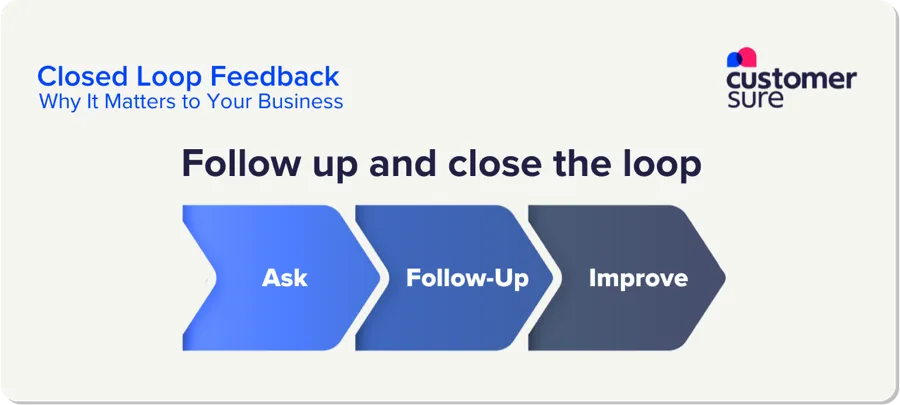
If you’re already doing this – great! But are you tracking how often you actually close the loop?
5. Feed the learning back into the business
This is the step many teams skip.
If five customers raise versions of the same problem, the loop is not truly closed until the owning team fixes the cause. Otherwise you are running a labour-intensive rescue operation instead of a customer improvement process.
That is why closed loop feedback works best when it connects frontline teams, CX, operations, and service owners rather than sitting in one reporting silo.
How quickly should you close the loop?
As a rule, the more serious the issue and the more vulnerable the customer, the faster the response should be.
Most teams benefit from a simple set of service levels such as:
- urgent complaints or high-risk cases: same day
- ordinary negative feedback: within one working day
- broader improvement ideas or non-urgent comments: reviewed in the next improvement cycle
The exact timings depend on your industry, but the principle is stable: customers should not have time to conclude that nobody is listening.
If the issue cannot be solved immediately, acknowledgement still matters. A fast response that sets expectations clearly is far better than silence.
Best Practices for Closing the Loop
Here’s what separates the average from the excellent:
- Prioritise urgent or negative feedback Fixing what’s broken should come first. You’ll reduce churn and frustration straight away.
- Don’t ignore the positives Praise is a powerful connector. Following up with happy customers builds loyalty too. Here’s why you should learn from your happy customers as well.
- Track closure rates It’s not enough to collect feedback. Track how often you reply and resolve it. CustomerSure’s feedback status system makes this easy.
- Separate acknowledgement from resolution Sometimes you can respond quickly but need longer to fix the root cause. Track both.
- Empower your teams Don’t trap feedback in the CX team. Give product, ops, and frontline staff access so they can act too.
- Report the impact on revenue & profit. How many customer losses have been avoided by prompt interventions? What high-impact business weaknesses have been identified and fixed? Has there been an increase in new customers via word-of-mouth referrals.
What should you measure?
If you want closed loop feedback to improve, you need more than a vague sense that the team is “following up”.
Useful measures usually include:
- Response rate to negative feedback: how often does someone actually reply?
- Time to first response: how quickly do customers hear back?
- Closure rate: how often does the case reach a clear outcome?
- Time to resolution: how long does it take to fix the issue?
- Repeat-issue volume: are the same problems surfacing again?
- Recovery outcome: after follow-up, did the customer stay, calm down, or improve their view of the experience?
These measures matter more than simply counting how much feedback you received. If you gather lots of comments but rarely act on them, the programme will feel busy without being especially useful.
Common mistakes that break the loop
Closed loop feedback fails when teams do one of these:
- respond with a generic template that shows no understanding of the issue
- leave the feedback in one team with no operational owner
- treat closing the loop as a complaint-only exercise
- fail to connect the customer-level fix with a wider process change
- collect comments faster than the business can respond to them
If any of those sound familiar, the solution is usually not “collect more feedback”. It is to tighten the workflow, clarify ownership, and make sure the process is realistic for the volume you receive.
Closing the Loop with CustomerSure
This is where we can help.
CustomerSure is built to make feedback meaningful, not just collected and forgotten. With our platform, you can:
- Route feedback to the right person in real time
- Track whether replies are sent and issues are resolved
- Automate follow-ups to close the loop with customers
- Share insights across teams so everyone stays in the know
Want to see how it works? Book a discovery call with us. We’ll show you how you can close the loop faster and easier.