We’ve covered the basics – what is Net Promoter and how do you calculate it?
But you can’t calculate your score without getting some responses, so we’ll show you, with examples, how to put together a NPS survey that will give you actionable data and a fantastic response rate, and how to send it out to your customers.
What’s the point of a Net Promoter Survey?
This might seem painfully obvious – but when we help people with their NPS projects, this is where we start, because making mistakes here will cause problems that undermine everything else.
Think of it as a house – if you don’t take time to build good, solid foundations, it doesn’t matter how you build the roof, what wallpaper you pick, or how many bathrooms you have – the house is going to fall down.
NPS was designed as a way of measuring loyalty. But, surprisingly, the biggest mistake we see people make is… Designing NPS surveys with a primary goal of measuring loyalty.
That’s not a typo.
You take your car to a mechanic, and they use a machine to measure its emissions. You go to the doctor, and they use a gizmo to measure your pulse. And you use a thermometer to measure the temperature.
But there’s a huge difference between a satisfaction survey and a thermometer: A thermometer (sadly) can’t make you warmer, but a feedback form can make or break customer experience in two ways:
- The form itself. How easy is it to fill in? Are you asking the right number of questions? And questions your customers want to answer? Does it enhance, or detract from, your brand? How many times have you been asked to fill in a “30-second” form, only to walk away in despair when you see the “30 page” survey?
- What happens next? It’s a terrible customer experience to be asked for feedback, and to have it completely ignored. Like being asked on a date, but then being stood up – it’s worse than not being asked at all. But this is what most companies do.
No customer, anywhere, wakes up in the morning feeling a burning need to have their loyalty measured.
So if the primary objective of your NPS survey is measuring loyalty, you’re not going to get great results. However much you try to hide it, all your decisions will give priority to ‘measuring loyalty’ ahead of anything else (‘service improvement’, ‘service recovery’, etc). Your customers will see straight through you.
Instead,
The primary goal of your NPS survey should be to provide a brilliant customer feedback experience. It’s fine to measure loyalty as a secondary goal, but it’s counterproductive to try and measure loyalty in a way which might decrease it.
It’s hard to improve customer experience if your voice of the customer initiatives have a poor customer experience.
So…
What questions should be on a NPS survey?
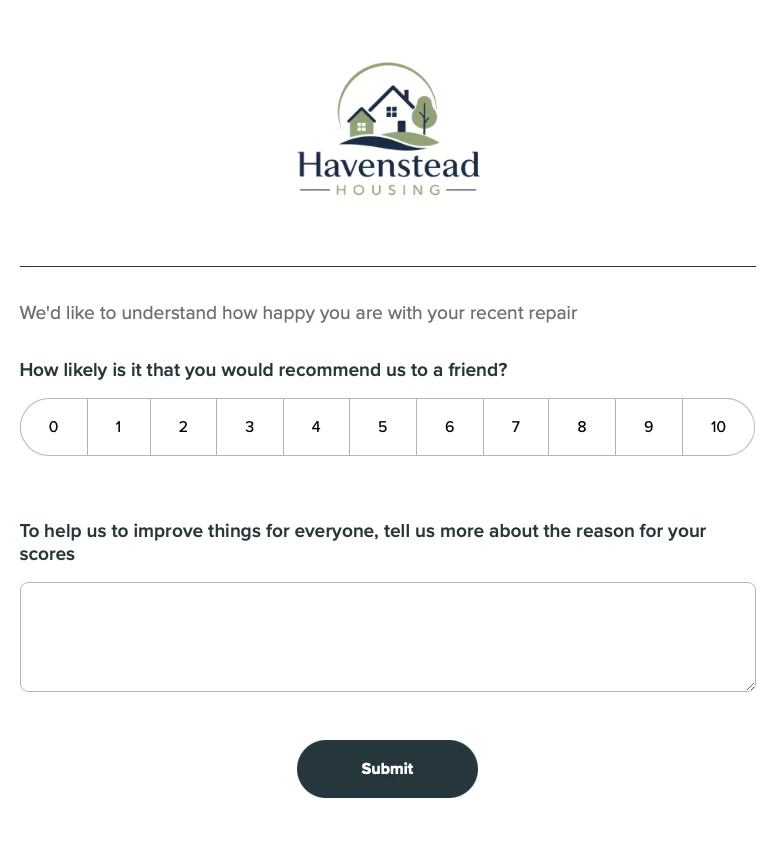
Let’s start with the basics. It’s not a NPS survey without the NPS question:

But as we’ve just discussed, simply measuring loyalty isn’t a great idea. You need to set out to improve it. And to improve it, we need to get inside our customers’ heads.
The best way to do this is by asking a single, open ended question. There are lots of different ways to ask it, so pick one that you feel works best for your circumstances.
But whatever you do, don’t overcomplicate things. Resist the temptation to ask twenty different open-ended questions: how are you feeling about our prices today?, how do you feel about the agent you spoke to?, how would you characterise our hold music? and please describe the warm, fuzzy feeling you have after contacting us.
Don’t make them think, and trust that if you give them that one textbox, they will tell you everything you need to know to retain their business.
Then, it’s up to you and your team to keep them happy by acting on what they tell you.
(If you’re building a mobile-first survey and wondering whether the classic 0-10 layout is overkill, we’ve also written a practical guide to calculating NPS on a 1-to-5 scale, including when that trade-off makes sense.)
A simple NPS survey template
Use this template when customers know your organisation well enough to form a view about whether they would recommend it:
- The recommendation question How likely are you to recommend [Company] to a friend or colleague?
- One open text question What’s the main reason for your score?
- Up to three short diagnostic questions Only if they reflect the things customers genuinely care about.
That’s enough to give you a headline NPS number, the reason behind it, and a small amount of extra direction on what to fix.
Keep the wording focused on the relationship, rather than a single interaction:
- Relationship NPS: How likely are you to recommend [Company] to a friend or colleague?
- B2B relationship NPS: Based on your experience of working with our team, how likely are you to recommend [Company] to a colleague in a similar role?
Do not rewrite the NPS question around a recent order, support case or repair. That asks customers to rate a specific interaction, so use CSAT or CES instead. The choice of metric matters more than finding a cleverer version of the recommendation question.
The point is not to create a catalogue of NPS wordings. It is to make sure the customer is thinking about the relationship you actually want to understand.
Which follow-up question should you ask after the NPS score?
The best default follow-up is still the simplest one:
What’s the main reason for your score?
That wording does three useful things:
- It works for promoters, passives and detractors.
- It invites explanation without leading the witness.
- It gives you language you can feed straight into a closed-loop feedback process.
Can a NPS Survey have more than 2 Questions?
Conventional wisdom holds that NPS is a 2-question survey. We’re here to tell you that it’s OK to ignore conventional wisdom, and we’ve got the data to prove it.
At CustomerSure, we help the teams who use our platform put themselves in their customers’ shoes and build feedback processes that those customers love being part of.
When we help people put their surveys together, we recommend adding a small number of ‘diagnostic’ scored questions, in addition to the ‘overall satisfaction’ question.
So for example,
- How well did we understand what you wanted?
- How easy were we to deal with?
- How would you rate our speed?
- How well did we communicate?
It’s good to ask questions like these because they’re aligned with what your customers want from you. So customers don’t mind taking a fraction of a second out of their lives to give you a score.
There’s a “rule” which comes from usability research which says that fewer questions on a form is always better, and that more questions will always annoy the busy person completing your form and impact your response rate, but this isn’t quite true.
Like most “rules”, reality isn’t so black-and-white. Yes, overwhelming a form with pointless questions that customers have no interest in answering will impact your response rate. But when you add a few carefully-chosen questions that their customers have a stake in answering, this is the result:

If ‘speed of response’ is important to a customer, and they trust that you’re listening, if they can tell you in under a second how good your speed of response is, they will.
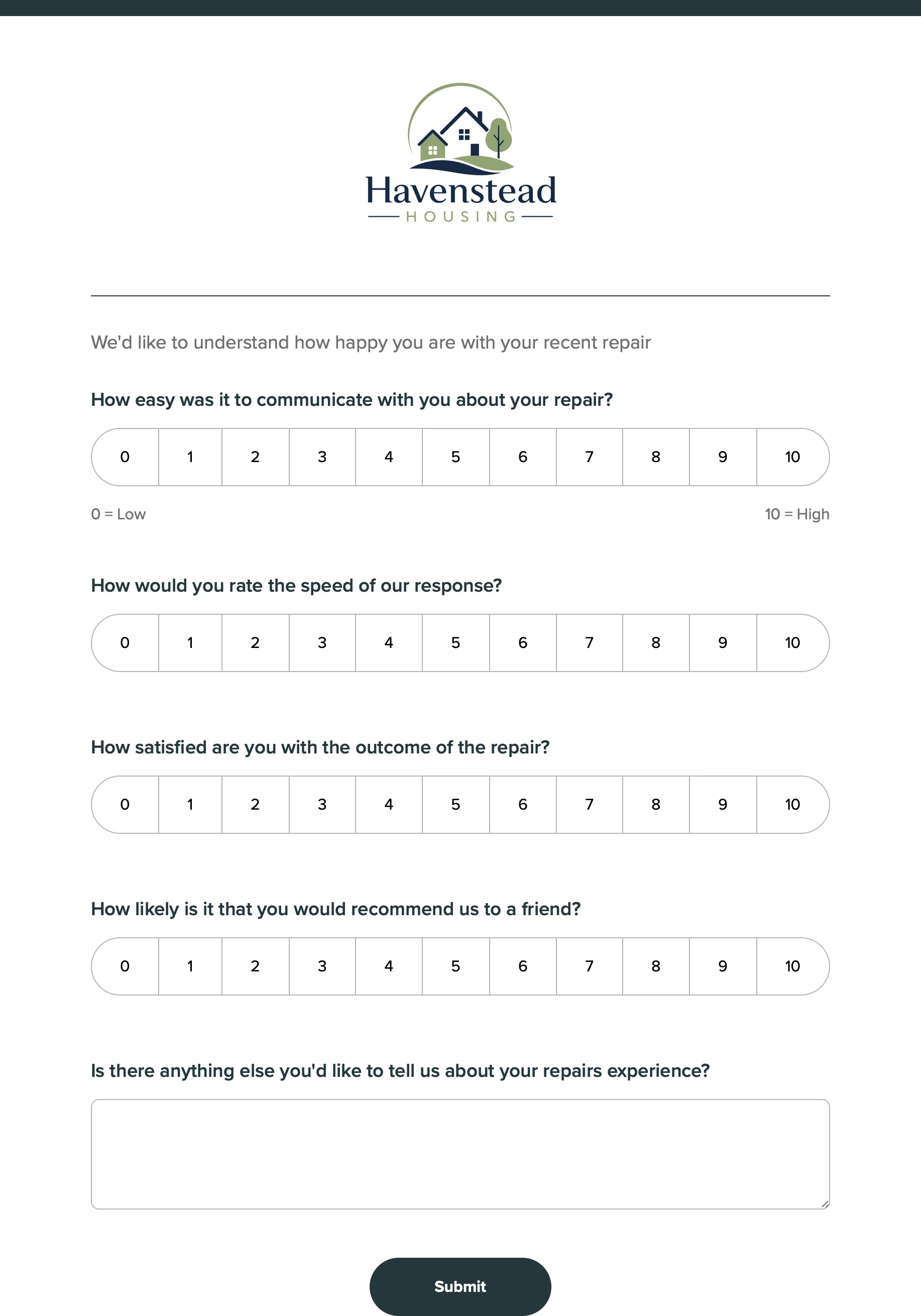
So it’s OK to ask these extra questions – they aren’t going to upset your customers and kill your response rate.
In exchange you get a constant ‘temperature check’ on the aspects of your service which are most important to your customers, and the ability to quickly put things right if you notice standards slipping.
When should you send a NPS survey?
Send an NPS survey when customers have had enough of a relationship with you to form a view about loyalty and recommendation. It is not the default question to ask after every transaction.
For feedback on a specific event, such as a purchase, support case, repair or onboarding step, use the metric that fits the question. CSAT or CES will usually tell you more about how that particular experience went, and give you something concrete to improve.
NPS is more useful as a relationship measure: a periodic check on whether the experience of dealing with your organisation makes customers willing to recommend it. Do not send it before a customer has had time to reach that view.
The timing still matters for every type of feedback. Ask close enough to a transaction that the details are fresh, but only after the customer can judge the outcome. If you are deciding when to send transactional feedback, our guide to survey timing explains how to choose the moment.
What should an NPS Survey Email Look Like?
We’ve already touched upon the ingredients of a great survey email elsewhere in this guide, but let’s bring them together into a short, easy-to-follow recipe.
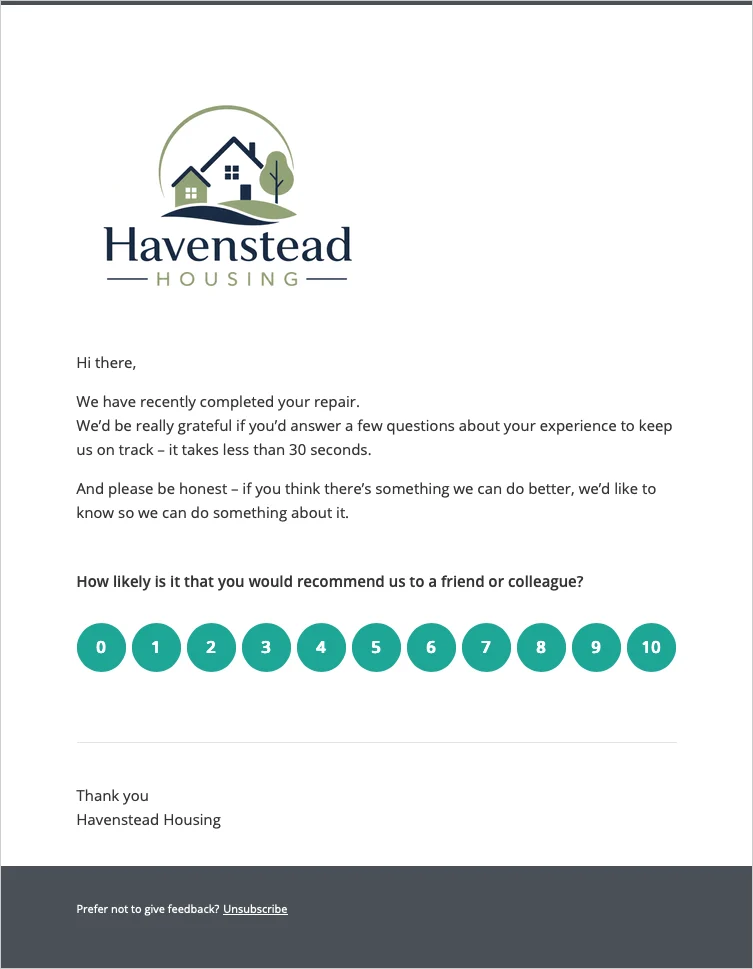
- Care for your customers – the only reason to send out an NPS survey is to improve loyalty, so be prepared to deal with any issues which you hear about from the free-text question.
- Show that you care – The single biggest barrier to customers giving you feedback is that they don’t trust you. They’ve been burned too many times before by companies who collected feedback but ignored it. Promise that you’re listening, promise that you’re going to put things right, then make good on your promises.
- The time is right – your customers have been also burnt by long, market research exercises masquerading as satisfaction surveys. Promise that your survey is going to take no more than 30 seconds to complete.
- Put a face to a name – tying into the previous two points – if you’re trying to build trust with your customers, including a person’s name and a headshot is a great way to reassure people that you’re listening.
If you want a more comprehensive guide to getting the right response rate for your surveys, we have one of those. And if you need the feedback to reach the people who can actually act on it, take a look at how to share customer feedback with employees. That part matters just as much as the survey wording. If you’d like to talk through any of the issues in this, or any of our guides with an expert, get in touch.