Some things reliably split a room: Marmite, pineapple on pizza, voice notes, and whether the office thermostat is ever set correctly.
One thing that most people wouldn’t put on that list? Rating scales on customer surveys. But it turns out that People have some pretty strong feelings about this
But the truth?
It doesn’t matter (much) what scale you use. (We’ll come back to that ‘much’ in just a moment…)
We’re not saying that “it never matters, ever, on any survey, what scale you use”. Because sometimes it’s vitally important. Just that it usually doesn’t matter for customer satisfaction surveys.
Why? It all comes down to the golden rule: see things from the customer’s point of view.
The scale you pick does not increase customer satisfaction, so give yourself permission to not get hung up on it. Instead, spend your time on things that will move the needle, like asking at the right time, in the right way, and listening to what people say.
It’s tempting to think that one scale might give you better results, but there’s three reasons why satisfaction surveys don’t work like that:
1. Improving customer satisfaction is different from market research.
In market research, the scale does matter. In order for the conclusions drawn from research to be safe, the questions have to be structured carefully to avoid biasing the responses.
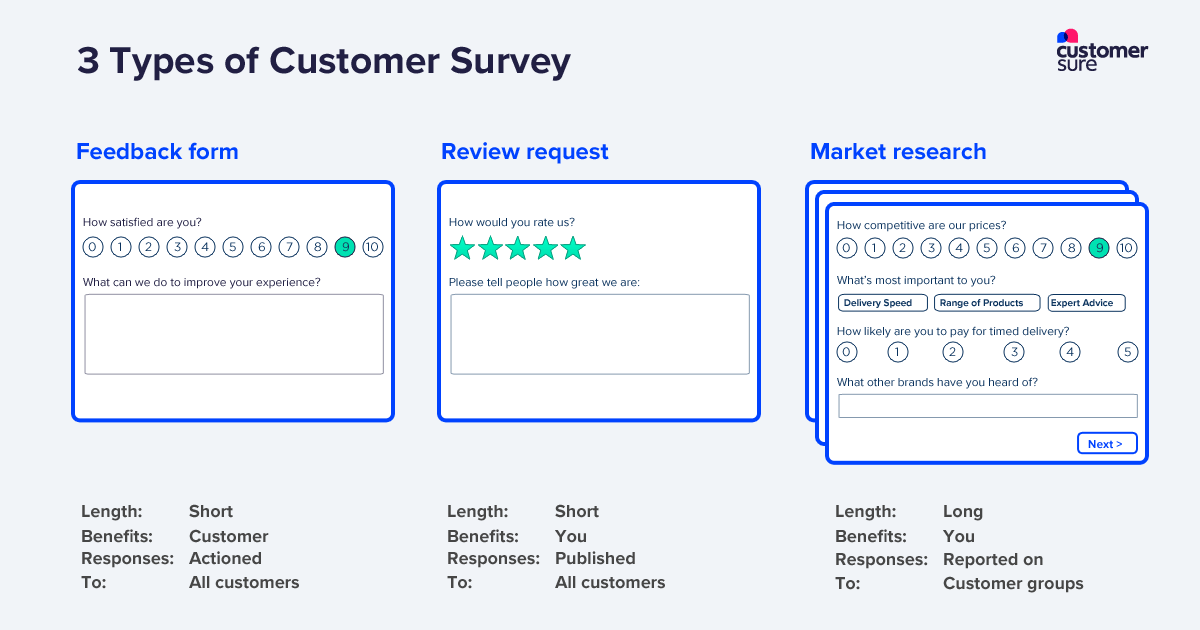
But if, right now, one of your customers is angry at you, then no amount of marketing or statistics is going to make them recommend you, or re-order from you.
It doesn’t matter if they’re “Dissatisfied”, “Big sad face”, two-out-of-five stars, or a 3/10 on the NPS scale. If you want them to keep being your customer, (and if you want to grow your business through their referrals) you need to fix the problem.
Market research has its place in your business, but this isn’t it.
When you’re acting on the results of a market research project, you need confidence that your sample size was correct and the questions weren’t biased, so you’re confident in the decisions you make from the research. The scale for your questions can matter there.
When you’re collecting customer feedback, you need to know if the customer’s happy, and if they’re not, you need to make them happy. Don’t worry about the scale.
2. The customer doesn’t care what scale you use.
What does your customer want in a satisfaction scale?
They want one they can answer quickly and get on with their lives.
So we admit it – the choice of scale does matter a bit. Don’t confuse your customers with something like:
Q: Would you recommend us to a friend?
A True / False / Very Happy / Don’t care
But as long as you pick something that actually makes sense and they can answer without having to think too hard, you’re good.
3. Customer satisfaction scores don’t matter anyway
Really?!
Pretty much, yes.
If an individual has given you 2/10, or ‘0 stars’, they’re telling you that you need to fix a problem. But the score is just shorthand for their actual feedback – and it’s the feedback itself you care about.
Think about it – if a customer’s left you highly critical feedback, but scored you a 7/10 (it happens!), are you just going to ignore their feedback because the score’s OK? Hopefully not.
So, scores for individual customers don’t matter that much.
But as soon as you start doing reporting and analysis on the scores, it matters even less.
It changes nothing whether you tell people you have an NPS of +40, that 70% of your customers are satisfied, or that you have a 5-star rating, it’s what you’re doing about those scores that counts.
If your NPS is +40 but last quarter it was +60, you may have problems. But if it’s shot up from -20, you’re doing amazingly well.
If you’re just looking at the numbers, rather than constantly working to improve the numbers, you’ll find it hard to move forward. So… just pick any scale and stick to it.
And if you’re picking a scale specifically because your competitors use it? Well, benchmarking’s a bad idea too.
Common survey rating scales and when to use them
If you’ve searched for “survey rating scales”, you’ve probably seen giant lists of different scale types. That’s useful background, but in day-to-day customer feedback work the real question is simpler:
Which scale will help customers answer quickly, and help your team act sensibly on the result?
Here’s a practical way to think about the main options:
| Scale | Best use | Strength | Watch out for |
|---|---|---|---|
| 0-10 numeric | Loyalty questions and NPS-style surveys | Familiar, flexible, easy to trend over time | Midpoint scores are open to interpretation unless the purpose is crystal clear |
| 5-point worded satisfaction scale | Transactional customer satisfaction checks | Fast to answer, easy to understand, works well on mobile | Less nuance than longer scales |
| 7-point scale | Research-heavy surveys where you genuinely need extra sensitivity | Gives more gradation for attitudinal questions | Harder for respondents to process quickly |
| Effort scale | Specific “how easy was this?” questions | Best fit for Customer Effort Score | Don’t use it as a substitute for satisfaction or loyalty |
| Stars / faces / emojis | Lightweight interfaces, kiosks, public reviews, or surveys designed for customers in vulnerable circumstances | Visually quick and low-friction | Best used deliberately, not as a default for every survey |
| Yes / No | Almost never for satisfaction | Simple to build | Too blunt to be useful when someone feels “somewhere in the middle” |
The key thing is to match the scale to the job. If you’re measuring likelihood to recommend, use a recommendation scale. If you’re measuring ease, use an effort scale. If you just want to know whether a recent interaction went well, a simple satisfaction scale is usually enough.
Should your survey use a 5-point, 7-point, or 10-point scale?
This is where most teams get stuck. In practice, the right answer depends less on statistical purity and more on the kind of feedback process you’re running.
5-point scales
A 5-point rating scale is often the best default for customer satisfaction surveys.
It’s easy to scan, easy to tap on mobile, and easy for frontline teams to understand when they’re triaging feedback quickly. If you’re asking customers about a recent interaction, and the goal is to spot problems and follow up fast, five points is usually plenty.
Typical example:
- Very satisfied
- Satisfied
- Neither satisfied nor dissatisfied
- Dissatisfied
- Very dissatisfied
7-point scales
A 7-point scale can be useful when you’re doing more research-oriented work and genuinely need extra nuance.
That might make sense in brand research, employee research, or more academic-style studies. But for operational customer feedback, the extra granularity often creates more hesitation than value. If customers are giving you feedback in the middle of their day, faster and clearer usually beats “more precise”.
10-point scales
A 10-point scale works well when you need compatibility with an established method, especially Net Promoter Score.
It can also be useful if your organisation already reports in tenths, or if you want a scale that can easily be mapped to percentages or simplified into five buckets later. But it asks more from the customer than a 5-point scale, so it’s most defensible when the specific method really matters.
If you’re using a 10-point scale for convenience rather than a genuine need, it’s worth asking whether a shorter scale would get you more responses and less friction.
Should survey rating scales use numbers, words, or both?
The short version: numbers are ideal.
You’re trying to make it easy for customers to answer, then read the comments and fix what’s broken.
That’s why numbered scales are usually best for customer feedback. They’re familiar, compact, easy to scan, and easy to report on consistently over time.
That said, text can still be useful.
Not because agonising over whether one person’s 7 is another person’s 6 is a useful way to spend your time, but because labels can make the question clearer at a glance. They can reassure customers they’ve understood what you’re asking, and they can help colleagues interpret the scale consistently.
So the practical rule is:
- numbers for speed and consistency
- text where it genuinely improves clarity
- and not so much wording that the scale becomes hard work
For example:
0 = Not at all likely5 = Neutral10 = Extremely likely
Or:
1 = Very dissatisfied3 = Neutral5 = Very satisfied
Make the ends of the scale unmistakable
Do not assume that a customer will interpret 1 and 5 the way you do. Label what the low and high ends mean, and keep that direction the same throughout the survey. A customer should never have to stop and work out whether a bigger number is better on this question but worse on the next.
For example, a satisfaction question might run from 1 = Very dissatisfied to 5 = Very satisfied. An agreement question needs different labels, such as 1 = Strongly disagree to 5 = Strongly agree. The numbers may look alike, but they are answering different questions; do not combine them into one headline score just because both use five points.
You do not need to label every point if the endpoints make the meaning clear. But do not reverse, recolour or otherwise change the direction to make a score look better. That makes feedback harder to answer and less trustworthy. The score is not the thing to optimise; the experience behind it is.
When icons can be better than words
There is one context where icons can be a very sensible choice: when you’re designing for accessibility, low literacy, English as a second language, or other forms of customer vulnerability.
In those cases, a simple faces or stars scale may reduce friction and help more people complete the survey successfully.
That doesn’t make icons universally “better”. It just means there are situations where making the survey easier to process matters more than sticking rigidly to a text-first format.
If you know a customer group may struggle with dense wording, then simpler visual scales are often the more customer-centric option.
Are Likert scales the same as customer satisfaction scales?
Not quite.
A Likert scale usually measures agreement with a statement, for example:
- “The process was easy to understand”
- Strongly agree → Strongly disagree
That can be useful if you’re trying to diagnose why an experience felt good or bad. But it isn’t exactly the same as asking for an overall satisfaction rating.
If your goal is to improve a journey, a good pattern is:
- one overall metric question
- a small number of driver questions
- and at least one open comment field
We go into that in more detail in our guide to what questions to ask on a VoC survey.
Not convinced?
Stop to think about why you’re collecting feedback.
Hopefully, it’s one of these reasons, or something similar, because they all have concrete business benefits:
- To take immediate action to improve a customer’s satisfaction.
- To make sure a customer is not going to leave you.
- To make sure there are no reasons preventing your customer buying additional services or recommending you to others.
- To learn what’s important to customers.
- To find and fix problems in your business processes.
- To make sure everyone on your team’s delivering to the standard your customers expect.
- To discover opportunities for sales, cost reductions or improvements in customer experience.
- To motivate everyone by confirming that you’re on track.
In any of those cases, how would changing the scale help you achieve that benefit?
You just need a scale, any scale with a “good end” and a “bad end”. And if a customer tells you that they’re at the “bad end” you need to take action.
OK, but seriously now, which scale should I use?
At CustomerSure, we like to keep things simple, so we recommend just going with a 0-10 scale.
- It’s easy to understand;
- It’s quite common so people are familiar with it;
- It’s compatible with Net Promoter Score®, if that’s what you want to do
- It’s easy to convert to five-star ratings, if that’s what you want to do
But really, anything that’s commonly used, and easy to understand is fine. If you do want to run NPS on a shorter scale, we’ve written up how to calculate NPS on a 1-5 scale and when that tradeoff makes sense.
And which scale should I absolutely never use?
We’re glad you asked.
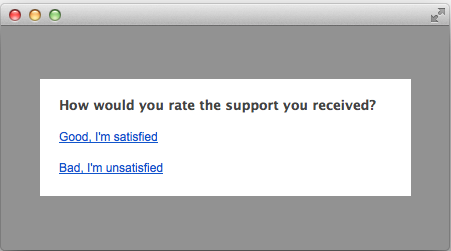
The old ‘either yes or no’ scale. Either “Satisfied/Unsatisfied”, or “Smiley face/sad face”. There’s two problems with doing this:
First, it forces you to an extreme, even if your feelings are not extreme. That’s annoying. The best case scenario is that customers filling this in will accept one of the two answers given, and resent you a bit for making them choose. The worse case scenario is that people abandon your form and you miss out on valuable feedback.
Any final tips?
Absolutely. Once you’ve picked a scale, stick to it. Don’t tax your customers’ brains by making them figure out different scales for different questions. People’s patience when they’re filling in forms is close to that of a two-year-old full of fizzy drinks.
And finally, remember that not every question on a feedback form should have a scale. Always provide at least one question which allows open comments. We’ve got a whole guide on feedback form design, but if you’re in a hurry, the key takeaway is that without providing a text question, you’ve got no way of knowing why the customer gave you their scores, and so no way of fixing any problems you find.