Across the housing sector, there has been significant investment in customer feedback software over the past few years. Most housing associations are now collecting more feedback than ever before, running surveys across key journeys and reporting regularly to boards and regulators.
On the surface, it would appear that the sector has made real progress.
But when you speak to housing associations in detail, a different picture begins to emerge.
The challenge is no longer about collecting feedback. That part is largely solved.
The real question is what happens next?
The Gap Between Insight and Action in Housing Associations
One of the most consistent frustrations expressed by housing associations is the gap between gathering insight and actually using it to drive change.
In many housing associations, feedback flows into a central team where it is analysed, filtered and reported on. That team then becomes responsible for translating insight into something actionable for the wider business.
Over time, this creates a bottleneck.
Insight becomes concentrated in a small group rather than distributed across the organisation.
As a result, the people who are best placed to act on feedback do not always see it in a timely or usable format. Repairs managers, housing officers and ASB teams may only encounter customer insight once it has been summarised, interpreted and passed through several layers.
In some cases, this leads to situations where large volumes of feedback are technically being reviewed, but not systematically acted upon. Issues that could have been resolved early instead develop into formal complaints because there is no structured follow-up process. The opportunity to intervene is missed, not because the insight is unavailable, but because it is not reaching the right people in the right way.
There is also a cultural dimension to this challenge. Teams can spend time debating small numbers of responses rather than taking action on them, or selectively engaging with feedback that reinforces existing views.
Technology alone cannot solve this, but it can either reinforce or reduce these behaviours depending on how it is designed.
What housing associations increasingly want is technology that routes insight directly to the point of action, rather than requiring everything to pass through a central analyst first.
Compliance Is Necessary, but Not Sufficient
Regulatory requirements such as Tenant Satisfaction Measures have added urgency and visibility to customer insight programmes. However, organisations are discovering that compliance alone does not deliver meaningful improvement.
Producing a report that meets regulatory standards is only one part of the picture. The more complex challenge is making that data useful.
Many housing associations are finding that boards are receiving large volumes of information from their customer feedback software without a clear understanding of what it means or what should be done next. This can lead to a form of paralysis where data is discussed extensively but not translated into action.
At the same time, there is a growing recognition that headline scores do not tell the full story. Housing providers want to understand why certain groups of residents are less satisfied, how complaints and feedback relate to each other, and where underlying issues are emerging before they escalate.
This has led to increasing demand for triangulation, bringing together different data sources such as complaints, vulnerability data and transactional feedback to build a more complete picture. Without this, organisations are left with isolated metrics rather than a coherent narrative.
Regulation is raising the stakes, but it is also exposing the limitations of approaches that focus purely on reporting rather than insight.
The Need for Earlier Signals
Another common theme is the timing of feedback.
Many housing associations have historically relied on periodic surveys that provide a snapshot of customer sentiment. While useful, these approaches often introduce a delay between the customer experience and the insight reaching the organisation.
By the time issues are identified, customers may already have disengaged or escalated their concerns.
There is a growing shift towards recognising the value of earlier signals.
Transactional feedback, captured close to the point of service delivery through customer feedback software, offers the opportunity to identify dissatisfaction quickly and intervene before it develops into a complaint.
This is particularly important in areas such as repairs, damp and mould or complex case management, where early intervention can significantly reduce both cost and risk. Organisations are beginning to see that catching issues earlier is not just a service improvement opportunity but a financial one, with the potential to reduce complaint handling costs and operational strain.
However, capturing feedback earlier also introduces new challenges. Data needs to be timely, representative and meaningful. Small sample sizes can lead to overreaction, while delays in sending surveys can distort results and reduce their value.
Housing associations are therefore looking for technology that not only captures feedback quickly but ensures that it is robust enough to support confident decision making.
AI That Supports, Not Replaces, Thinking in Customer Feedback Software
Artificial intelligence (AI) is increasingly part of the conversation, but expectations are more nuanced than might be assumed.
There is clear frustration with customer feedback software that require significant manual input to produce useful outputs. In some cases, teams are exporting data into external tools because built-in analytics are not delivering the level of insight required. In others, AI outputs are too generic, too broad or occasionally incorrect, which undermines confidence in the platform.
What organisations are asking for is not more automation for its own sake, but smarter automation that reduces effort without removing control.
They want customer feedback software that can identify trends and themes without needing constant prompting, but that also present information in a way that allows business users to interpret and act on it. Overly prescriptive outputs can be just as unhelpful as overly manual ones.
Trust is a critical factor here. When AI produces results that are clearly inaccurate or misaligned, it can erode confidence not just in that feature but in the platform as a whole. As a result, reliability and clarity often matter more than sophistication.
From Frustration with AI to Insight You Can Trust
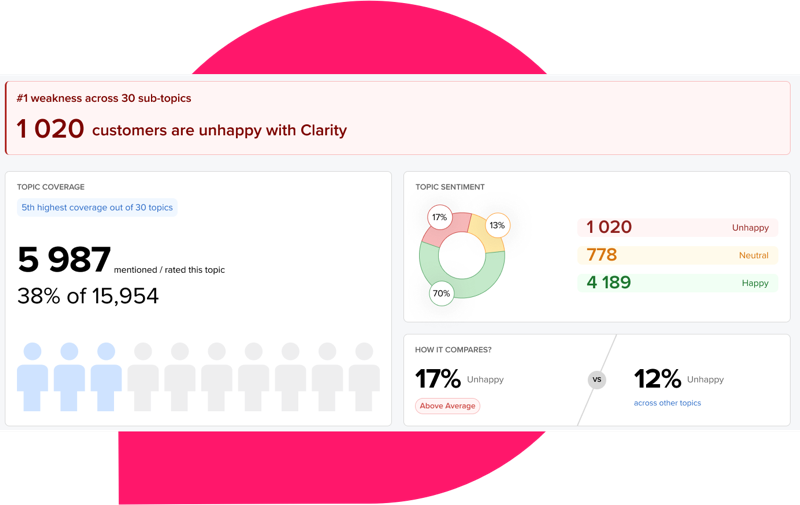
Housing associations are not looking for automation for its own sake. Instead they are turning to AI which helps to reduce manual effort, surface meaningful themes and enable teams to act with confidence.
CustomerSure’s AI-powered intelligence does exactly that. Our platform turns high volumes of feedback into clear, reliable insight that reaches the right people at the right time.
Understanding and Supporting Vulnerability in Housing Associations
Vulnerability has become a central consideration for housing associations, driven by both regulatory expectations and a broader focus on resident wellbeing.
Identifying vulnerable customers is only the first step. The real challenge is ensuring that this information leads to appropriate action.
Housing associations are increasingly looking for customer feedback software that can connect vulnerability signals to operational workflows, ensuring that flagged cases receive the right level of attention and support. This may involve prioritising certain cases, adapting communication methods or triggering specific follow-up processes.
There is also a strong emphasis on governance and data protection. The handling of vulnerable customer data carries significant responsibility, and organisations need confidence that platforms are managing this information securely and appropriately.
In addition, accessibility remains an important consideration. Not all customers engage with digital channels in the same way, and inclusive approaches to feedback collection are essential to ensure that all voices are heard.
Communicating Insight at Board Level
Even when insight is available from customer feedback software, presenting it effectively remains a challenge.
Long, detailed reports can overwhelm stakeholders and reduce engagement, while overly simplified summaries may miss important nuances. Striking the right balance is critical.
Housing providers are increasingly looking for ways to present insight in a format that is both concise and meaningful, highlighting key themes, risks and opportunities without requiring extensive interpretation.
There is also a growing awareness that how information is presented can influence how it is received. Leading with strengths before moving to areas for improvement can create a more constructive conversation and reduce defensiveness among stakeholders.
Ultimately, boards are not just looking for data. They are looking for clarity on what is happening, why it is happening and what should be done next.
Linking Feedback to Performance
Customer feedback is also becoming more closely linked to operational and contractor performance.
Housing associations want to understand how satisfaction varies across different teams, regions and contractors, and to use this information to inform performance management and commercial decisions.
This requires a level of granularity and consistency that many customer feedback software have struggled to provide in the past. Without clear visibility, it becomes difficult to identify where issues are occurring and how they should be addressed.
At the same time, there are sensitivities around how feedback is used, particularly where it is linked to contractual performance measures. Ensuring that data is representative and fairly interpreted is essential to maintaining trust across both internal teams and external partners.
A Shift from Centralised Insight to Distributed Ownership
Underpinning all of these themes is a broader structural issue.
In many housing organisations, customer insight sits within a central team that is responsible for collecting, analysing and reporting on feedback. While this model provides control, it can also limit the impact of insight if ownership is not shared more widely.
What housing associations increasingly want is technology that enables insight to be distributed across the organisation, placing it directly into the hands of those who can act on it.
This is not just about improving efficiency. It is about changing how organisations think about customer data.
When insight is embedded into day-to-day operations, it becomes part of how services are delivered rather than something that is reviewed after the fact. It supports earlier intervention, better decision-making and a more consistent understanding of the resident experience.
The organisations that are moving fastest in this space are not those collecting the most data. They are the ones making it easiest for their people to use it.
Transitioning from Manual to Automated Processes in Customer Feedback Software
Alongside better insight, there is also a clear demand to reduce the manual effort that still surrounds many feedback programmes.
In too many housing associations, customer feedback software workflows still rely on exporting data into spreadsheets, manually filtering results, forwarding reports via email, or setting up alerts that require human intervention to be useful.
This not only slows down response times but also increases the risk of inconsistency and error.
Housing associations are increasingly looking for technology that removes these manual steps through automation. This includes the use of APIs to connect customer feedback software, automatically pushing insight into CRM or operational platforms, triggering workflows without human input, and ensuring that feedback reaches the right people instantly.
The goal is not simply efficiency for its own sake, but creating a seamless flow of information where insight moves at the same speed as service delivery.
And that, ultimately, is what housing associations really want from their customer feedback software.
Move from Collecting Feedback to Acting on It
The challenge for housing associations is no longer collecting feedback. It’s ensuring that feedback reaches the right people and drives action early. See how CustomerSure helps organisations distribute insight, reduce delays and turn feedback into meaningful change across teams.


Darren Wake
Darren Wake leads Customer Success at CustomerSure, where he helps clients act on feedback in ways that improve retention, increase revenue, and reduce customer effort. With a background in marketing, research, and experience design, he’s worked with teams across sectors to align internal processes with what matters most to customers. Known for his practical, plain-speaking approach, Darren helps organisations keep things simple, focus on the essentials, and deliver measurable improvements.