Voice of the Customer means using real customer feedback — rather than assumptions — to improve your business.
Voice of the Customer works best when it is treated as an operational discipline, not just a survey exercise.
This guide explains what VoC is, how a VoC programme works, and how to use customer feedback to improve retention, service quality, and growth.
Briefly, What is Voice of the Customer?
In short, Voice of the Customer means ‘listening to your customers and doing something about it’.
Many firms try to do the first part (listening), but due to problems with how they listen, they struggle with the ‘doing’ part.
What’s the history of VoC?
Unlike Net Promoter, VoC isn’t one “thing”, with one “inventor”, and a single, unchangeable definition.
It’s a term which has evolved over time, starting in the late 1960s.
Pioneers like Yoji Akao and W. Edwards Deming were responsible for systems, mainly in manufacturing, which aimed to produce the best-possible products by deeply understanding customer needs.
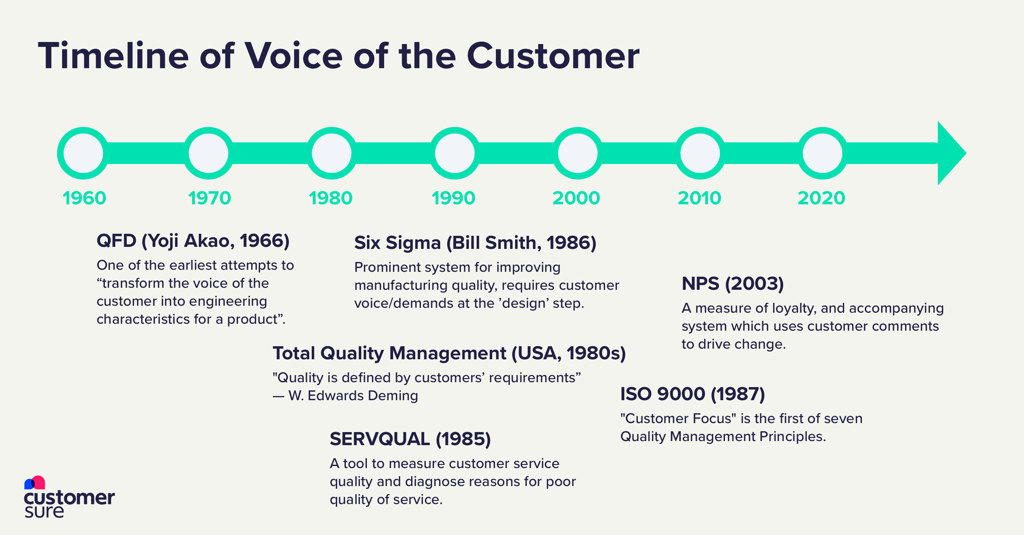
These systems were a huge factor in producing businesses that can build the consumer products we enjoy today. But although they definitely incorporated ‘the voice of the customer’, they didn’t really address customer service or customer experience, as we understand those terms in the 2020’s.
This was largely because back in the ‘60s, manufacturing was a much larger part of the economy. But gradual changes, accelerating rapidly from the 1980s have shifted the economy gradually towards the ‘services’ sector, with a commensurate need to use VoC to measure and improve the quality of these services.
So, the 80s saw attempts to use Voice of the Customer to improve service quality. An early model, still used today, was Parasuraman’s SERVQUAL model, but the most fundamental shift arrived in 2003 when Fred Reichheld introduced Net Promoter.
Net Promoter: The template for ‘modern’ VOC.
A lot gets written about NPS (we’re as guilty as anyone), but a lot of it misses the point (hopefully we’re not as guilty of this).
You can debate endlessly how to calculate NPS, what benchmarks to use, what the perfect NPS Survey looks like, but none of those things will materially improve customer experience, and thus, revenue.
The designers of NPS are pretty clear: To improve customer satisfaction, NPS requires a ‘closed inner loop’.
Otherwise, it’s just sending surveys and hoping for the best.
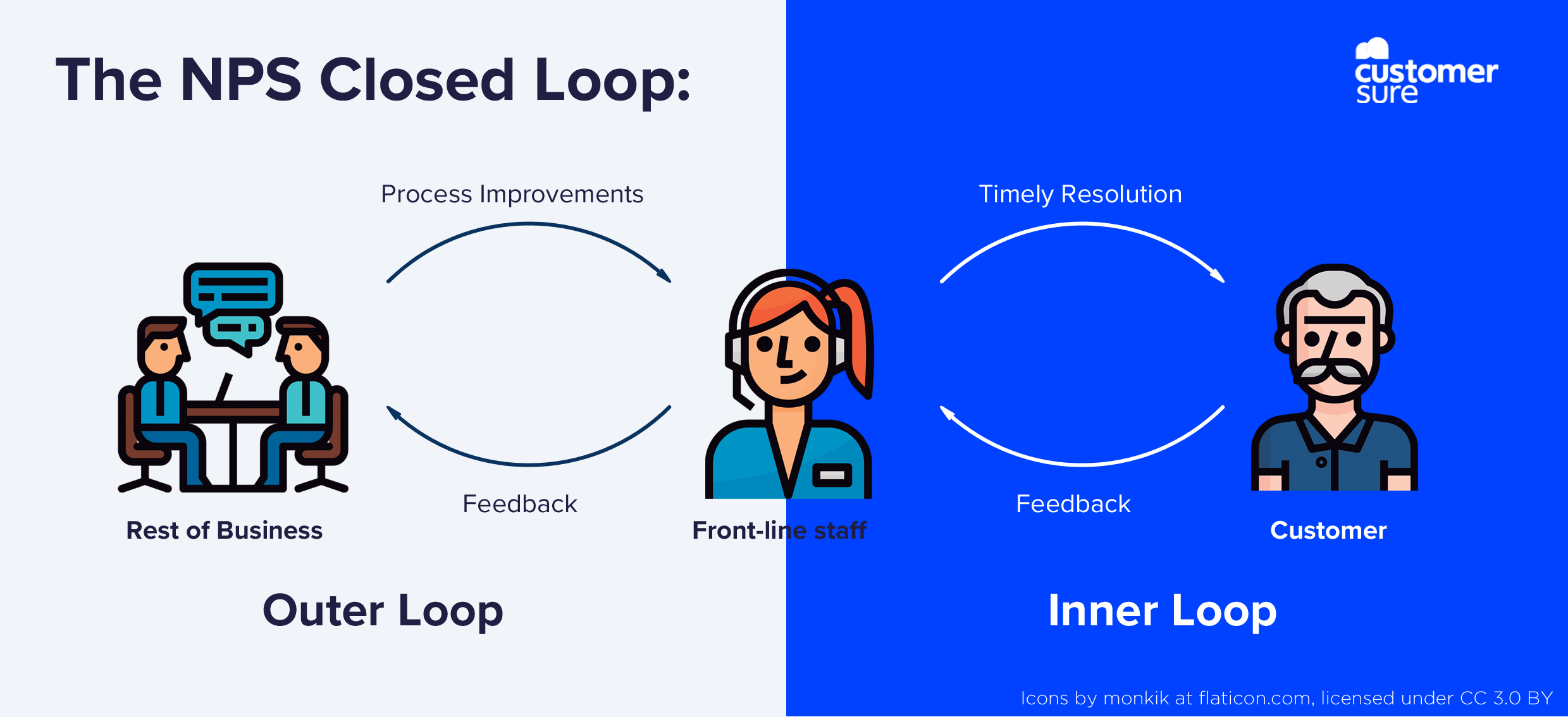
This closed loop is the mark of a modern VoC system that improves your bottom line.
- The ‘Inner Loop’ ensures that individual customers have their voices heard: Any problems they have with services or products get a timely resolution.
- The ‘Outer Loop’ ensures the collective ‘voice’ of all customers is used to consistently improve the entire business over time.
Modern, best-in-class, Voice of the Customer improves customer experience in the short-term and long-term.
What Voice of the Customer means in practice, today
In practice, a good VoC programme does five simple things:
- It asks customers about things they care about
- It makes it easy for them to answer honestly.
- It routes their feedback to the people who can act on it.
- If urgent service recovery is needed, it enables that service recovery to take place, and demonstrates its effectiveness.
- It uses the patterns in that feedback to improve the business over time.
That’s why VoC is not just a survey programme, a dashboard, or a metric.
It may well use NPS, CSAT and other satisfaction metrics, or open-text comments. But those are only useful if they sit inside a system that helps you first fix things, and then learn the patterns in what’s going wrong, and what the business should change.
That also means VoC is different from pure market research.
Market research is often about testing ideas before a purchase decision. A Voice of the Customer programme is usually about improving the real experience customers are having with your business right now, across real journeys and touchpoints.
What a Voice of the Customer programme should include
When people search for “voice of the customer”, they are often really asking what a working VoC programme looks like in the real world.
At minimum, it needs four parts:
- Collection: A way to gather feedback from the right moments in the journey.
- Interpretation: A way to work out what the customer actually means, how urgent the issue is, and whether it is a one-off or a pattern.
- Action: A way to get urgent issues to the right person quickly enough for service recovery to happen.
- Learning: A way to spot recurring themes and turn them into changes to products, services, policy, training, or process.
If one of those parts is missing, the programme becomes lopsided:
- plenty of surveys, but no action
- dashboards for leaders, but no follow-up for customers
- quick fixes for individuals, but no long-term improvement across the business
That is why a proper VoC programme is not just “collecting customer feedback”. It is a management system for improving customer experience continuously.
Where Voice of the Customer data comes from
If you only use one source of feedback, you only get one angle on the truth.
The strongest VoC programmes combine a few different sources:
1. Direct feedback
This is the obvious one: customers tell you what happened.
Examples include:
- transactional surveys after support calls, deliveries or claims
- relationship surveys that track how the wider account or customer base feels
- open-ended VoC questions that let people explain what needs fixing
Direct feedback is the clearest way to hear the customer’s own words, but it works best when you ask at the right moment and keep it easy to answer.
Don’t be seduced by attractive-sounding passive listening or signal analysis. In a relationship, you wouldn’t just try and infer what your partner is thinking by watching their behaviour. You ask questions, at the right time, about how they’re feeling.
Treat your customers like your loved ones, you’ll find that as long as you ask at the right time, in the right way, and deliver follow-up, they’ll tell you what they’re thinking.
2. Indirect feedback
Customers also tell you what they think in places you don’t control.
That might include online reviews, complaints, social posts, sales-call notes or contact-centre transcripts.
This kind of feedback can support surveys, because it often captures what people say when they’re not trying to be polite, and not answering a company-written questionnaire.
3. Operational signals
Some of the best VoC clues are behavioural rather than verbal.
For example: repeat contacts, abandoned journeys, low renewal rates, unresolved complaints, or sudden changes in survey response rate.
On their own, those signals don’t tell you why customers are struggling. But when you combine them with survey and comment data, they help you pinpoint where the experience is breaking down.
Which VoC methods should you use?
The right mix depends on the type of business you run, but most successful programmes use a blend of methods rather than relying on a single channel.
Surveys
Use surveys when you need structured feedback you can compare over time: NPS, CSAT, CES, or open-text follow-up questions.
Surveys are strong for benchmarking and spotting patterns, but weak if you send them at the wrong time or ask too many questions.
Interviews and account reviews
Use interviews when you need depth, nuance, and strategic context.
They are especially useful in B2B, financial services, and complex service environments where a single score cannot explain the whole relationship.
Interviews can give you much more depth about your wider business environment: customer pain points, competitive insight, rather than the more focused data you can collect from transactional feedback at customer journey touchpoints.
Complaints, reviews and unsolicited feedback
Use unsolicited feedback when you want the issues customers care enough about to raise without being prompted.
Complaints, review sites, social media and support conversations are useful because they often reveal friction that a formal survey would miss.
Behavioural and operational data
Use operational signals when you need to identify trouble before customers spell it out explicitly.
Examples include repeat contact, cancellations, low renewal rates, delayed resolution, and sudden falls in response rate.
The best programmes combine these methods so they can answer three questions:
- What are customers saying?
- What are customers doing?
- Which of those issues matter enough that we should act now?
Benefits of Voice of the Customer
We’ve already established that VoC — especially in its research-focused forms — improves the products and services a company produces in the long-term: better cars, nicer phones, new airline routes and so on.
But what are the benefits of modern VoC that ensures customers are happy at every touchpoint?
The article linked above goes into a lot of depth about nine benefits of VoC, but if we were to summarise the top 5:
- More repeat customers: This hopefully goes without saying. Fix problems quickly, and customers are more likely to come back because they trust that even if things go wrong at first, they will end up going right.
- More new customers: Making customers happier boosts your reputation through word-of-mouth. A better reputation means more people forming a queue to buy from you.
- Lower churn: Not all churn is inevitable. A lot of attrition can be averted by simply finding customer issues and fixing them before they start talking to your competitors.
- Easier up-sell and cross-sell: proactively listening to customer needs opens up conversations which wouldn’t otherwise occur. These conversations are an opportunity to discover new needs, and introduce customers to your offerings which meet these needs.
- A happier team: A real VoC programme which shares feedback with your team improves performance and morale, which in turn — surprise! — improves customer service.
Voice of the Customer Success Stories
Here are some teams that used Voice of the Customer well enough to produce visible results:
VoC Success Story 1: Covéa Insurance

Covéa, a large, UK-based insurance firm has a long track record of caring deeply about their customers. However, they sensed that a more immediate and engaging Voice of the Customer process was possible.
CustomerSure worked with the Covéa team to modernise their VoC programme, resulting in them gaining a far broader and deeper insight into their business.
With an agile platform, and a culture shift towards customer feedback being part of ‘business as usual’, the Covéa team have been able to rapidly investigate multiple touchpoints, collect feedback, and improve their business more rapidly.
VoC Success Story 2: Barchester Healthcare

As a a premium care provider, it’s absolutely imperative that Barchester put quality at the forefront of everything they do. But it’s not easy to manage the diverse views of both home residents and their family and friends, across over 250 care homes nationwide, across a range of different business functions: From food and beverages, to the activities offered to residents.
Barchester worked with CustomerSure to build a robust Voice of the Customer programme, capable of making customer feedback available to the right people at the right time to take action to directly improve resident satisfaction.
The result? Three years of consistent NPS improvement.
VoC Success Story: GBG

GBG are global specialists in identity intelligence. They offer a suite of products around identity verification and fraud prevention to a variety of industries.
Working with CustomerSure, the GBG team streamlined their global VoC programme, ensuring every customer is able to leave feedback, and crucially, this feedback can be escalated quickly to a complaints system if needed.
Because feedback is part of ‘business as usual’, satisfaction remains high, customer comments are used to improve GBG’s products and services, and GBG have became sophisticated enough with VoC to publish a ‘you said, we did page, demonstrating to current and future customers that they take customer experience seriously.
Voice of the Customer Best Practices
The exact steps will depend on a firm’s current level of VoC maturity and its business goals.
But we’re always guided by these three principles:
-
Get feedback at the best time: Before setting up your VoC programme, make sure you have a clear picture of your customer journeys and their touchpoints. Review — from the customer’s point of view — when they would like to give you feedback.
-
Make it easy: Once you’re asking at a convenient time, make sure you’re asking in a convenient way. Use the customer’s preferred channel, make sure the VoC questions you ask match customer goals rather than business goals. And don’t use design patterns that upset users, like multi-page surveys.
-
Act on the feedback: The case for acting on the feedback your Voice of the Customer surveys collect is both moral and financial. It shouldn’t need repeating in 2024, but asking people what they think and ignoring them falls below the baseline experience that people expect.
And, if you ask-and-ignore, don’t be shocked if your customers reply-and-switch-to-a-competitor. It’s better to have not asked at all, rather than to raise hopes to disappoint them.
These three rules are our way of structuring the foundation of any successful VoC programme: design it around the customer, and business benefit will naturally follow.
How to build a VoC programme
There’s a catch-22 at the heart of every VoC project.
To achive business goals (the increased revenue we discussed earlier), the programme needs to be designed around customer goals, not business goals.
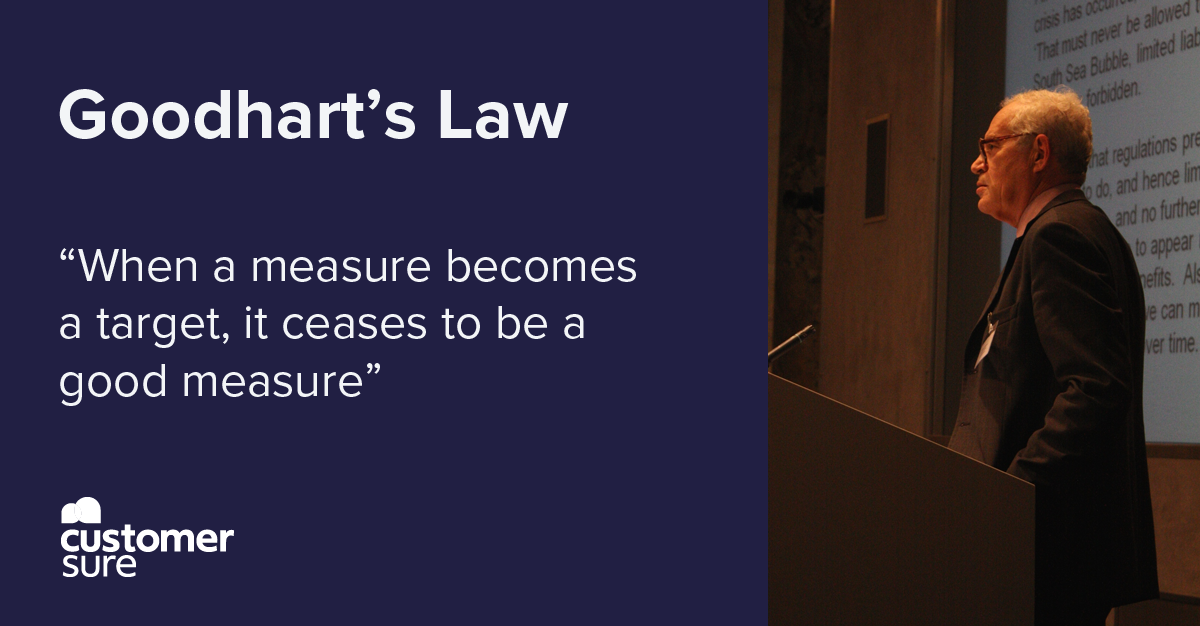
The moment you start placing the business’ needs over customer needs, i.e. ‘what can we do to maximise response rate?’ or ‘how do we improve NPS from 60 to 70?’, Goodhart’s Law is likely to kick in, and you’re likely to optimise to hit these targets (higher response rate, higher NPS)…
But these targets don’t ‘magically’ lead to a healthier bottom line.
You win the financial benefits by making customers genuinely happier. Feel free to measure response rate, NPS, CSAT, or anything else… But target an improved bottom line.
In practice, you need to move through the following steps:
Stakeholder Engagement
Businesses who succeed with VoC are customer-centric from the top down. Ask a senior leader to choose between cost-saving and customer-pleasing, and they’ll choose the latter.
Before you embark on your VoC project, you should ensure that senior leadership are completely bought-in to your objectives. If the project is seen as a ‘nice to have’ rather than a foundation of your customer experience strategy, it doesn’t stand much chance of success.
Everyone involved in the project must agree on the project’s goals, how they’ll be measured, and what success will look like.
(Here’s a guide to putting a VoC business plan together).
Roles and Responsibilities
Once the goals are defined, based on a shared understanding of ‘success’, you need to work out how to achieve these goals.
Who is responsible for immediate follow-up? Who has authority and budget to make sure that the business makes the long-term, structural improvements that customers will ask for? How will the board be updated on progress and results?
Pilot
Pick one touchpoint, and start gathering customer feedback. Ensure that that the processes you’ve put in place are actually working. Tweak anything that isn’t quite right.
Once you’re happy that for this one customer touchpoint, dealing with feedback is just part of ‘business as usual’, it’s time to…
Roll-out and Review
Gradually expand the number of touchpoints that your VoC programme is covering, until customers have the opportunity to give you feedback on every meaningful interaction.
Periodically review the project, to ensure it’s still achieving what it set out to achieve. You’ll need to carry out both strategic reviews to assess whether the programme is still meeting its goals; and tactical reviews: are you still asking the right questions, over the right channels, at the right time to hit those goals?
What a working Voice of the Customer system looks like
The reason so many VoC projects disappoint is that they stop halfway through.
They collect feedback. They measure it. They produce a report on long-term improvements
But they don’t create a reliable loop from customer comment to business action. More importantly, they skip the service recovery phase, meaning customers churn before they ever see the benefits of the planned improvement works.
A working loop normally looks more like this:
- Capture: ask for feedback at the touchpoints that matter most.
- Interpret: identify the issue, the urgency, and the team that should own it.
- Act: fix the immediate problem for the customer where appropriate.
- Improve: review recurring themes and make structural changes.
If feedback doesn’t reach the right person, quickly enough, the customer sees no benefit and the business learns nothing useful. That’s exactly why Voice of the Customer programmes fail even when the software looks impressive on paper.
How to analyse VoC feedback and prioritise action
This is where a lot of VoC programmes lose their way.
They collect scores. They gather comments. They even produce a monthly report.
But they never establish a reliable method for answering three hard questions:
- What exactly are customers unhappy about?
- Where in the business is that problem worst?
- Which issue should we fix first?
In CustomerSure, the right way to do this is not to start with a dashboard full of top-line metrics.
The right way is to work through the analysis in a specific order.
1. Structure the feedback around things you can actually improve
The first step is not analysis at all. It is setup.
If your feedback is only stored as a score and a free-text comment, you can read it, but you can’t analyse it consistently at scale.
In CustomerSure, use topics and sub-topics to structure feedback around things a team can actually improve. These represent the specific things customers can feel positively or negatively about: speed, communication, staff knowledge, cleanliness, billing clarity, and so on.
This matters because analysis gets much better when the system can distinguish:
- what the customer is talking about
- how they feel about it
- which sub-topic is specific enough for a team to own
If your topics are vague, your analysis will be vague. If your sub-topics are clear and actionable, your reporting will be clear and actionable too.
2. Combine scores and comments instead of trusting either on its own
The next mistake teams make is treating scores as “quantitative truth” and comments as anecdote.
In practice, the richest insight comes from combining both.
In CustomerSure, you should analyse topics using both:
- rating questions linked to that topic
- AI analysis of the customer’s comment
That matters because customers often give a decent score while writing a very pointed complaint in the comment box. In CustomerSure’s Strengths and Weaknesses report, negative comment sentiment takes precedence when score and text conflict, because the comment is often the truer guide to what needs fixing.
That is a better basis for analysis than relying on NPS, CSAT or CES alone.
3. Start with “how widespread is the problem?”, not “which comment sounds worst?”
Once the feedback is structured, the first strategic question is:
What are the most widespread causes of customer frustration across the base?
In CustomerSure, start with the Strengths and Weaknesses report. That is the right first report for deciding what deserves attention.
It ranks topics by the number of unhappy or happy customers, rather than just showing a score average. That is important. A topic can have intense negativity in a small pocket of feedback, but still be less important than a milder issue affecting far more customers.
The correct first pass is:
- Open Strengths and Weaknesses
- Look at the top weaknesses
- Ask which topics affect the largest share of customers in scope
- Ignore the temptation to jump straight to one dramatic individual comment
That gives you the right starting point for prioritisation.
4. Drill into the topic before deciding what the fix is
Once a topic surfaces as a weakness, don’t jump straight from “customers are unhappy about communication” to “we need communication training”.
Open the topic and inspect the evidence properly.
In CustomerSure, the next step is to drill into the topic and check:
- coverage: how many customers mentioned or scored that topic at all
- sentiment mix: how many are happy, neutral, or unhappy about it
- trend over time: whether the problem is getting better, worse, or flat
- ratings vs comments: whether the numeric score and the verbatim feedback tell the same story
- customer list: the individual responses behind the headline
This is the point at which analysis becomes diagnosis.
For example:
- if the topic is negative in ratings and comments, the issue is probably clear and widespread
- if ratings are positive but comments are negative, you may have a survey-design problem, a wording problem, or a hidden friction point the score is masking
- if the topic is worsening month by month, it deserves more urgency than a long-standing but stable annoyance
5. Use heatmaps to find where the issue lives
A topic-level weakness still does not tell you where to intervene.
The right next move in CustomerSure is to use heatmaps and topic views to break the issue down by team, site, region, brand, or other reporting segments.
This helps you distinguish between three very different situations:
- a business-wide problem that needs a central process fix
- a localised problem affecting one branch, team, or journey stage
- a mixed picture where one area is performing brilliantly and another is dragging the average down
That distinction is crucial. Without it, teams often launch a company-wide initiative to fix what is actually a local problem, or they blame one team for an issue that is really systemic.
6. Use driver analysis to decide what deserves budget
Some issues are common but not very consequential. Others are mentioned less often but have a much stronger relationship with overall satisfaction, loyalty, or effort.
After identifying the main weaknesses, the next question should be:
Which of these topics actually drives our top-line metrics?
In CustomerSure, use driver analysis to see which topics and sub-topics correlate most strongly with metrics like NPS, CSAT or CES.
That stops teams prioritising purely by noise or gut feel.
If “speed of response” is only the fourth-most mentioned issue, but it has the strongest relationship with dissatisfaction, it may deserve to be fixed before more frequently mentioned but lower-impact problems.
7. Keep operational triage separate from strategic improvement
This is one of the most important distinctions in VoC analysis.
Some feedback needs individual follow-up. Some feedback needs organisational change. Some needs both.
In CustomerSure, handle that split by separating:
- topics and sentiment for analysis
- labels for categorisation and workflow
- feedback status for ownership and follow-through
For example:
- “Complaint”, “Needs reply”, or “Vulnerable customer” can be handled through labels and triage rules
- the feedback can then be assigned to an owner and tracked with feedback status
- meanwhile, the underlying topic pattern can still feed your strategic reporting
That separation is essential. It prevents teams from confusing:
- a serious single case that needs urgent action now
- with a recurring pattern that requires process redesign over time
8. Use AI to accelerate reading, not replace judgement
In CustomerSure, AI should be used to accelerate analysis, not replace it. It helps in three useful ways:
- assign topics and sentiment to comments
- apply labels
- generate summaries and starting-point action plans
That makes large data sets far more manageable, especially when you are trying to understand hundreds of comments on one sub-topic.
But the right habit is still:
- use AI summaries to spot the common pattern quickly
- read the underlying customer comments
- sanity-check any surprising classification
- then decide what to change
AI should compress the reading workload, not become a substitute for actually understanding the customer.
9. Finish analysis with an owner and a testable change
Analysis is only complete when somebody can say:
- what the issue is
- where it is happening
- how big it is
- why it matters
- who owns the next step
That next step should be concrete.
Not “improve communication”.
More like:
- rewrite the appointment confirmation message
- retrain one team on explaining next steps
- fix a handoff between support and operations
- change a policy generating repeated complaints
If the output of your analysis is still a vague theme rather than a named owner and a testable change, you have not finished the job.
How do you know whether your VoC programme is working?
The obvious answer is “scores go up”, but that is too simplistic.
A healthier test is whether your programme is producing evidence of better decisions and better outcomes. For example:
- urgent issues are being resolved faster
- recurring causes of complaints are being removed
- teams can show which changes were made because of customer feedback
- leaders can connect feedback themes to retention, growth or the broader customer experience business case
If your VoC programme only produces monthly charts, but no clearer priorities and no visible changes for customers, it is probably still immature.
Common mistakes teams make with VoC
Once a business starts taking feedback seriously, the next risk is taking the wrong lesson from the data.
The most common traps are:
- treating VoC as a board-reporting exercise rather than a management system
- optimising for response rate or score movement instead of genuine service improvement
- copying a generic survey template instead of designing around the customer journey
- relying on review sites as though they are the whole VoC strategy rather than one small input
That last one is a common trap: Review sites are essential for some B2C businesses, but they usually capture only a thin slice of the customer experience, often after the damage is already done. They are not a substitute for a proper Voice of the Customer programme that catches problems earlier.
Need help?
If you’re at a mid-market firm, and in the early stages of setting up a Voice of the Customer programme, you don’t have to do all the hard work yourself.
We’ve probably worked with someone just like you to build a project just like the one you’re planning.
We can share our years of experience to help you get there quicker. Tell us a bit about yourself, and let’s talk!